

CargoWise captures every transaction, but visibility comes from how you analyze it.
Every shipment milestone, customs declaration, warehouse movement, transport update, accrual, and financial posting is tracked in CargoWise. It is one of the most comprehensive logistics execution systems available to freight forwarding companies. However, while the platform excels at processing operational transactions, obtaining consolidated, real-time performance insights can be difficult. Standard reports frequently remain module-specific, static, or reliant on manual exports.
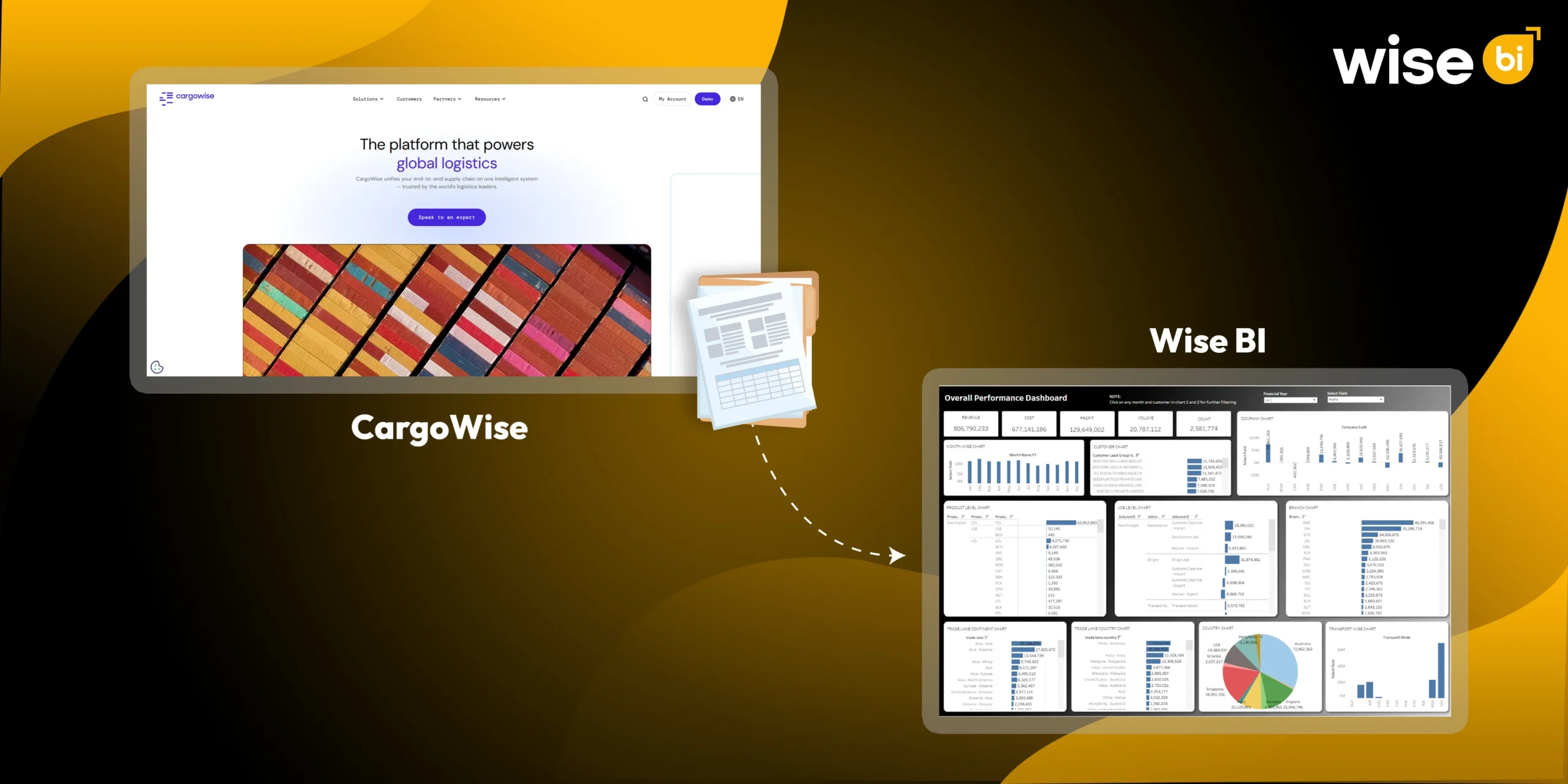
BI dashboards enhance CargoWise by transforming structured transactional data into dynamic, cross-module intelligence, allowing operations, finance, and management teams to monitor KPIs, track profitability, and manage exceptions more precisely and quickly.
CargoWise Data Challenges Faced by Logistics Teams
CargoWise is a powerful logistics execution platform that integrates forwarding, warehousing, transportation, customs, and financial operations into a single system. While the platform efficiently processes transactional data, many logistics teams struggle to gain real-time visibility and actionable insights. These difficulties are frequently caused by limitations in reporting structure, data consolidation, and analytical accessibility, rather than a lack of data.
Manual Reporting Challenges
Even though CargoWise is a powerful system, many freight forwarding and 3PL companies continue to rely heavily on manual reporting processes.
- Operations teams spend hours exporting reports from different modules
- Data is consolidated manually using spreadsheets and pivot tables
- Cross-department reconciliation is required to align operational and financial figures
- Reports often represent historical snapshots rather than live performance
- Increased risk of human errors in calculations and data entry
- Outdated information reduces responsiveness to shipment disruptions
Manual reporting consumes valuable operational time, which could be better spent on shipments, carrier coordination, and customer service.
Limited Real-Time Visibility
Logistics operations require continuous monitoring of shipment milestones, warehouse insights, and financial KPIs. However, standard reporting frequently excludes real-time performance tracking.
- Shipment status updates may lag behind actual operational events
- Warehouse inventory levels are not always visible in dynamic dashboards
- KPI monitoring, such as SLA compliance or transit time variance, is delayed
- Exception management becomes reactive rather than proactive
- Early warning indicators for margin erosion or shipment delays are often missing
Without live BI dashboards, teams respond to issues after service levels have been impacted rather than proactively preventing disruptions.
Data Scattered Across Modules
CargoWise operates across several interconnected modules, including
- Freight Forwarding
- Customs
- Warehouse Management
- Transport
- Finance and Accounting
Although the system centralizes operations, analytical insights are often distributed across modules.
- Shipment data may not directly align with job-level profitability
- Warehouse performance metrics may not integrate with customer billing data
- Carrier performance may not automatically link to trade lane analysis
- Financial postings may lack operational context in reporting views
This dispersed data structure makes it difficult to create a consolidated operational dashboard that reflects the entire logistics lifecycle.
Complexity for Non-Technical Users
CargoWise is reliable and highly customizable, but extracting meaningful analytics can be difficult for non-technical users.
- Customizing reports often requires technical knowledge or database queries
- Advanced KPI calculations may need SQL expertise or IT support
- Dashboard customization options can be limited in native reporting
- Operational users may struggle to drill down into performance deviations quickly
- Management reporting often depends on a small number of technical specialists
This complexity slows the gathering of data and increases reliance on IT teams.
Impact on Logistics Decisions
When data visibility is limited or delayed, the operational impact grows significantly.
- Shipment delays are identified too late to prevent SLA breaches
- Cost overruns or margin leakage remain undetected until financial closing cycles
- Miscommunication occurs between operations, warehouse, and finance teams
- Trade lane optimization decisions lack real-time performance data
- Supply chain planning becomes reactive rather than strategic
Finally, fragmented visibility reduces operational agility, erodes financial control, and limits the organization’s ability to scale effectively.
How do BI Dashboards Address CargoWise Data Challenges?
Business Intelligence (BI) dashboards convert raw CargoWise transactional data into structured, real-time, decision-ready insights. Instead of using static reports and spreadsheet consolidation, BI tools work directly with CargoWise databases to provide dynamic visualization, cross-module analytics, and automated KPI monitoring. This shifts logistics teams away from reactive reporting and towards proactive performance management.
Centralized Cross-Module Visibility
BI dashboards eliminate data silos by consolidating data from all CargoWise modules into a single analytical layer.
- Combine Forwarding, Customs, Warehouse, Transport, and Finance data into unified BI dashboards
- Align shipment milestones with job-level profitability
- Connect warehouse throughput with billing and revenue recognition
- Link carrier performance to trade lane and customer-level analytics
- Enable drill-down from management KPIs to individual job records
This provides a comprehensive operational view of the entire logistics lifecycle rather than isolated module-based insights.
Real-Time KPI Monitoring
Unlike static reports, BI dashboards are updated automatically based on system data, providing near-real-time performance visibility.
- Live tracking of on-time delivery percentage
- Transit time variance analysis by carrier or trade lane
- Dynamic job profitability monitoring
- Inventory turnover and warehouse utilization metrics
- SLA compliance dashboards with exception alerts
Teams can use real-time KPI tracking to identify bottlenecks and resolve operational issues before they become a problem.
Automated Data Consolidation
BI platforms automate data extraction and transformation, eliminating the need for manual spreadsheet-based reporting.
- Automatic ETL (Extract, Transform, Load) processes from CargoWise databases
- Scheduled data refreshes without manual exports
- Standardized KPI definitions across departments
- Elimination of reconciliation errors between operations and finance
- Centralized data warehouse for historical trend analysis
Automation reduces reporting workload while improving data accuracy and consistency.
Advanced Visualization & Drill-Down Capabilities
BI dashboards convert complex logistics data into easy-to-understand visual formats, reducing decision time.
- Interactive shipment analysis insights
- Margin analysis by customer, trade lane, or service type
- Carrier performance scorecards with filtering options
- Warehouse productivity heat maps
- Customizable views for operations, finance, and executive teams
Users can drill down from high-level summaries to detailed job-level transactions without needing SQL expertise.
Empowering Non-Technical Users
BI dashboards make analytics more accessible to operations teams and management.
- User-friendly visual interfaces
- Role-based dashboards tailored to operations, warehouse, or finance
- Self-service reporting capabilities
- Reduced dependency on IT or database specialists
- Faster insight generation during daily operational reviews
This increases data access and allows for faster, more informed decision-making across departments.
Proactive Exception Management
One of the most significant advantages of BI integration with CargoWise is the ability to transition from reactive reporting to proactive control.
- Automated alerts for delayed shipments
- Early warning indicators for declining margins
- SLA breach risk notifications
- Carrier performance deviation tracking
- Inventory imbalance alerts
Logistics teams can take corrective action before it affects customer service or profitability by using structured BI dashboards and exception alerts.
Choosing the Right Business Intelligence Approach
Implementing BI dashboards for CargoWise requires more than just choosing a visualization tool; it also necessitates developing a structured analytics strategy that is aligned with your logistics workflows, data architecture, and operational objectives. The right BI strategy ensures scalability, data accuracy, and long-term ROI while causing minimal disruption to day-to-day operations.
This leads to a strategic decision. Explore our detailed comparison of in-house BI teams and Wise BI’s ready-to-use BI dashboards to discover how implementation speed, internal expertise, and long-term scalability goals influence the best course of action.
Conclusion
CargoWise is a powerful logistics execution platform, but without structured analytics, much of its data remains underutilized. BI dashboards transform it from a transactional system into a performance intelligence engine, connecting operations, warehouse, transport, customs, and finance into one unified view.
Real-time KPI tracking, automated reporting, and proactive exception management help teams move from reactive firefighting to strategic control. Ready to gain full visibility into your CargoWise data? Schedule a free demo today and start making better decisions based on real-time logistics data.