

You have the data; why is decision-making so slow? Most freight forwarders today lack clarity, not data.
Every shipment, invoice, job, and milestone is already captured inside CargoWise. If all the data is there, why do decisions still take time?
The answer is found in CargoWise reporting gaps.
These gaps are not the result of missing data. They result from disconnected data, delayed visibility, and limited reporting options. These gaps have a long-term impact on profitability, operational efficiency, and customer experience.
The issue isn’t CargoWise itself. It’s the reporting gaps between data and decision-making. And this is exactly where CargoWise BI dashboards change the game.
Understanding Reporting Gaps in CargoWise
A CargoWise reporting gap does not mean a lack of information. It is about being unable to connect and interpret that information effectively.
In a typical CargoWise configuration, data flows through multiple modules:
- Forwarding operations
- Accounting and finance
- Warehousing
- Customs and compliance
Each module functions well independently. But when it comes to cross-functional visibility, things start to fall apart. This disconnect creates blind spots, which result in delayed or inaccurate decisions.
Data Silos that Break Visibility
CargoWise stores data across multiple modules, but these datasets frequently become disconnected. Operations, finance, and warehouse teams all have their own perspectives, making it difficult to understand the overall business picture.
- Operations teams focus on shipment progress
- Finance teams focus on billing and costs
- Warehouse teams track inventory and movement
However, without a unified view, these datasets remain isolated.
The result?
You do not see how operational performance directly affects financial outcomes.
Limited Built-In Reporting Capabilities
Standard CargoWise reports are useful for basic tracking, but they do not always enable deeper business analysis. As reporting requirements increase, teams struggle to generate customized insights.
When companies want deeper insights, like
- Profitability across global shipments
- Overall customer analysis trends
- Revenue and volume analysis comparisons
They frequently hit limits.
This requires manual workarounds, such as exporting data, merging reports, and creating custom spreadsheets.
Data Accessibility Challenges
Accessing CargoWise data for reporting or analytics often necessitates technical knowledge. Business users may rely on IT teams to extract and prepare data.
In many cases, organizations need:
- Technical expertise to extract data
- Database-level access
- Support from IT teams
- Internal BI team and CargoWise specialist
This reduces reporting speed and increases reliance on technical resources.
Data Quality and Consistency Issues
Inconsistent data entry across teams can lead to inaccurate reporting. Even small variations can create discrepancies in analysis.
For example:
- Different charge codes are used for the same service
- Variations in data entry formats
- Missing or incomplete job information
This gradually erodes trust in reports and renders analysis untrustworthy.
Skill Gaps in Data Analysis
Not every logistics team possesses dedicated analytics expertise. As a result, data is frequently underutilized or used only on a basic level.
Without dedicated BI resources:
- Reports become manual
- Insights remain surface-level
- Advanced analytics is underutilized
This limits the ability to make data-driven decisions.
Difficulty Integrating External Data
To make informed logistics decisions, businesses frequently require more than just CargoWise data. They rely on external sources such as financial systems, ERP platforms, and performance benchmarks.
However, integrating these data sources with CargoWise is frequently difficult and resource-intensive.
As a result:
- Financial data may not align with operational reports
- Performance comparisons remain incomplete
- Teams lack a consolidated view of business metrics
Decision-makers are forced to work with fragmented insights rather than a unified, accurate picture due to the lack of easy integration.
Lack of Real-Time Insights
In logistics, timing has a direct impact on performance and profitability. Delays, disruptions, and cost fluctuations require immediate visibility to take appropriate action.
However, traditional CargoWise reporting often falls short when it comes to real-time insights.
Most reports are:
- Generated weekly or monthly
- Based on historical data
- Already outdated by the time they are reviewed
This delay causes a critical gap between operations and decision-making.
Instead of preventing problems, teams respond to them after they occur, resulting in inefficiencies, missed opportunities, and lower service quality.
Scalability and Performance Limitations
As logistics companies expand, the volume and complexity of data increase significantly. Managing and analyzing this growing dataset is difficult without a scalable reporting infrastructure.
Without the ability to scale reporting systems, performance slows, and insights become more difficult to generate.
- More shipments
- More customers
- More financial transactions
Without a scalable reporting infrastructure, performance suffers, and it becomes more difficult to generate insights quickly.
Why does Traditional CargoWise Reports Fall Short?
The problem isn’t a lack of data in CargoWise. It is that traditional reporting methods do not fully realize their potential.
Most standard reports include:
- Static and non-interactive
- Limited in customization
- Focused on individual modules rather than the whole business
This requires teams to spend more time preparing reports than using them. In a fast-paced logistics environment, that delay puts you at a competitive disadvantage.
What are CargoWise BI Dashboards?
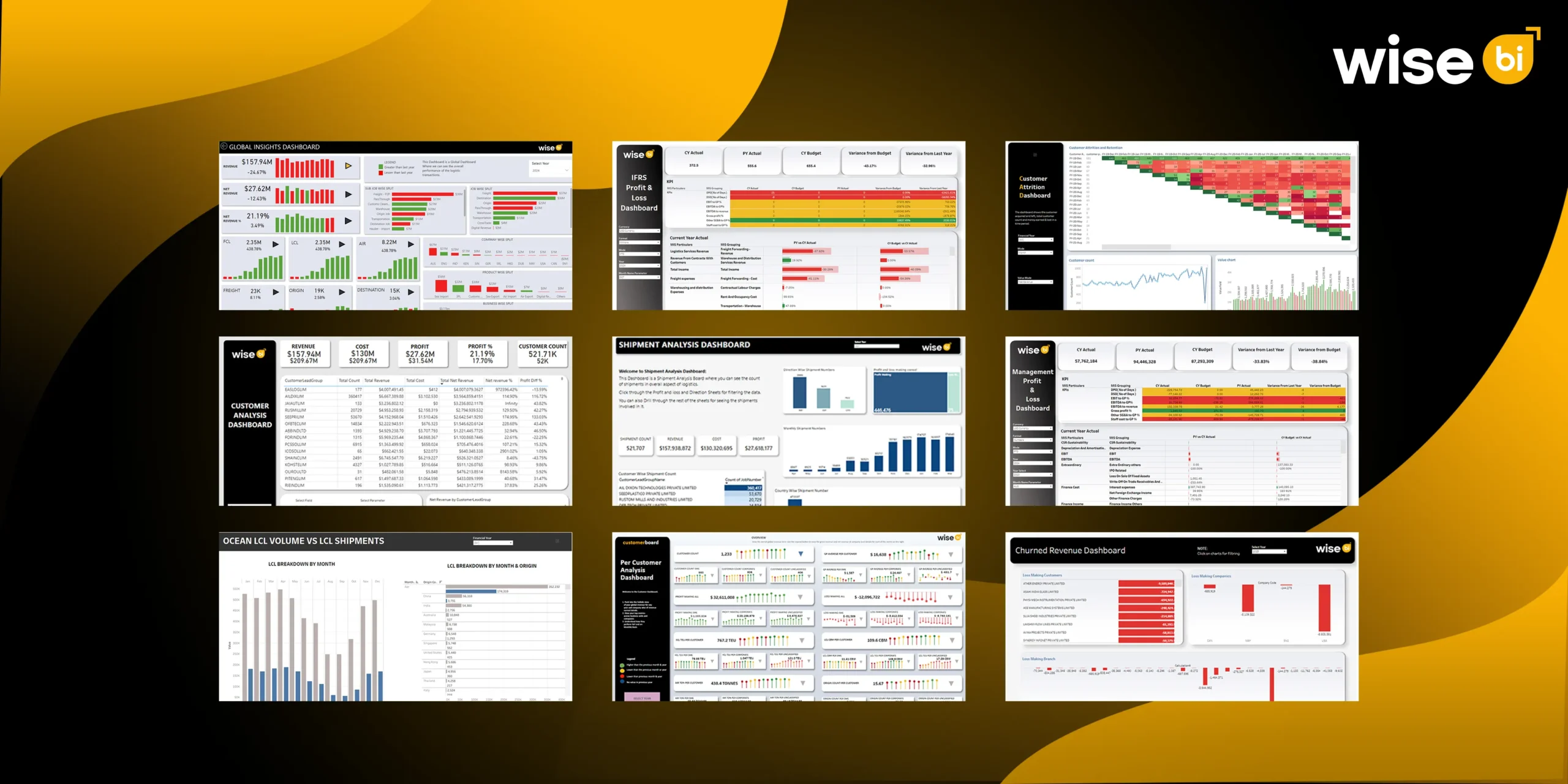
CargoWise’s BI dashboards convert raw data into clear, visual, and actionable insights. Instead of working with multiple reports, dashboards offer a consolidated view of your entire operation.
They allow you to:
- Track performance in real time
- Monitor key metrics across departments
- Analyze trends and identify issues quickly
More importantly, they simplify complex data so that it can be understood and acted upon by non-technical users.
How does CargoWise BI Dashboards Address Reporting Gaps?
Bringing everything into one unified view. CargoWise BI dashboards break down silos by combining data from various modules into a single interface.
This means you can:
- Compare operational performance with financial results
- View end-to-end shipment lifecycle insights
- Understand how different parts of your business interact
Enabling Real-Time Visibility
Instead of waiting for reports, CargoWise BI dashboards are updated on a continuous basis.
This gives you the ability to:
- Track real-time shipment data.
- Track cost changes as they happen
- Respond immediately to disruptions
Automating Reporting Processes
Manual reporting is no longer needed. Wise BI’s CargoWise BI dashboards automate:
- Data extraction
- Report generation
- KPI tracking
This not only saves time but also reduces the risk of human error.
Customizing KPIs for Your Business
Each logistics company operates differently. CargoWise BI dashboards enable you to track metrics that are truly important to your business, such as:
- Profit per shipment
- Country-level visibility
- Trade lane efficiency
- Customer-level profitability
- Cost leakage
Providing Deep Drill-Down Capabilities
Instead of just seeing summary numbers, you can dig deeper into the details.
For example:
- Start with the overall performance
- Drill down to specific shipment jobs
- Analyze individual invoices and cost components
This speeds up the identification of problems and the implementation of corrective measures.
Aligning Teams with a Single Source of Truth
When everyone uses the same CargoWise BI dashboard:
- Operations, finance, and management stay aligned
- Communication improves
- Decisions become faster and more accurate
How does it Affect and Help the Bottom Line?
Closing reporting gaps not only improves visibility but also directly affects financial performance by allowing for faster decision-making, better cost control, and increased overall operational efficiency.
- Allows for faster, real-time decision-making
- identifies low-margin shipments early.
- Reduces manual effort and errors
- Prevents revenue leakage
- Enhances customer response and service
Finally, closing reporting gaps transforms data into actionable insights, resulting in better decisions, increased profitability, and long-term business growth.
Impact of Closing CargoWise Reporting Gaps
Once BI dashboards are implemented, the difference is clear.
Before:
- Disconnected reports across teams
- Heavy reliance on Excel
- Delayed insights
- Limited visibility
After:
- Unified, real-time BI dashboards
- Faster and smarter decision-making
- Clear visibility across operations and finance
- Scalable reporting for business growth
This transformation extends beyond CargoWise reporting, creating a more agile, data-driven organization.
Conclusion
CargoWise already provides the data. However, growth is driven by insights rather than data alone.
If your team is still spending hours building reports, reconciling numbers, or attempting to connect data across systems, you are not utilizing CargoWise to its full potential. Ready to maximize the value of your CargoWise data? Book a free demo with us today to begin making smarter, faster decisions.