

Inbound operations are often the most underestimated part of warehouse management until something goes wrong. A sudden surge of shipments, delayed unloading, or slow putaway can quickly disrupt the entire workflow. When there is no clear visibility into what’s arriving and how it’s being processed, even well-planned warehouses struggle with inefficiencies, bottlenecks, and inventory inaccuracies.
This is where a CargoWise warehouse inbound dashboard becomes essential. It provides real-time visibility, structured data, and actionable insights into inbound operations, allowing teams to stay ahead of disruptions rather than react to them. Turning CargoWise complex operational data into clear, visual intelligence helps warehouses improve control, speed, and overall performance.
What is a CargoWise Warehouse Inbound Dashboard?
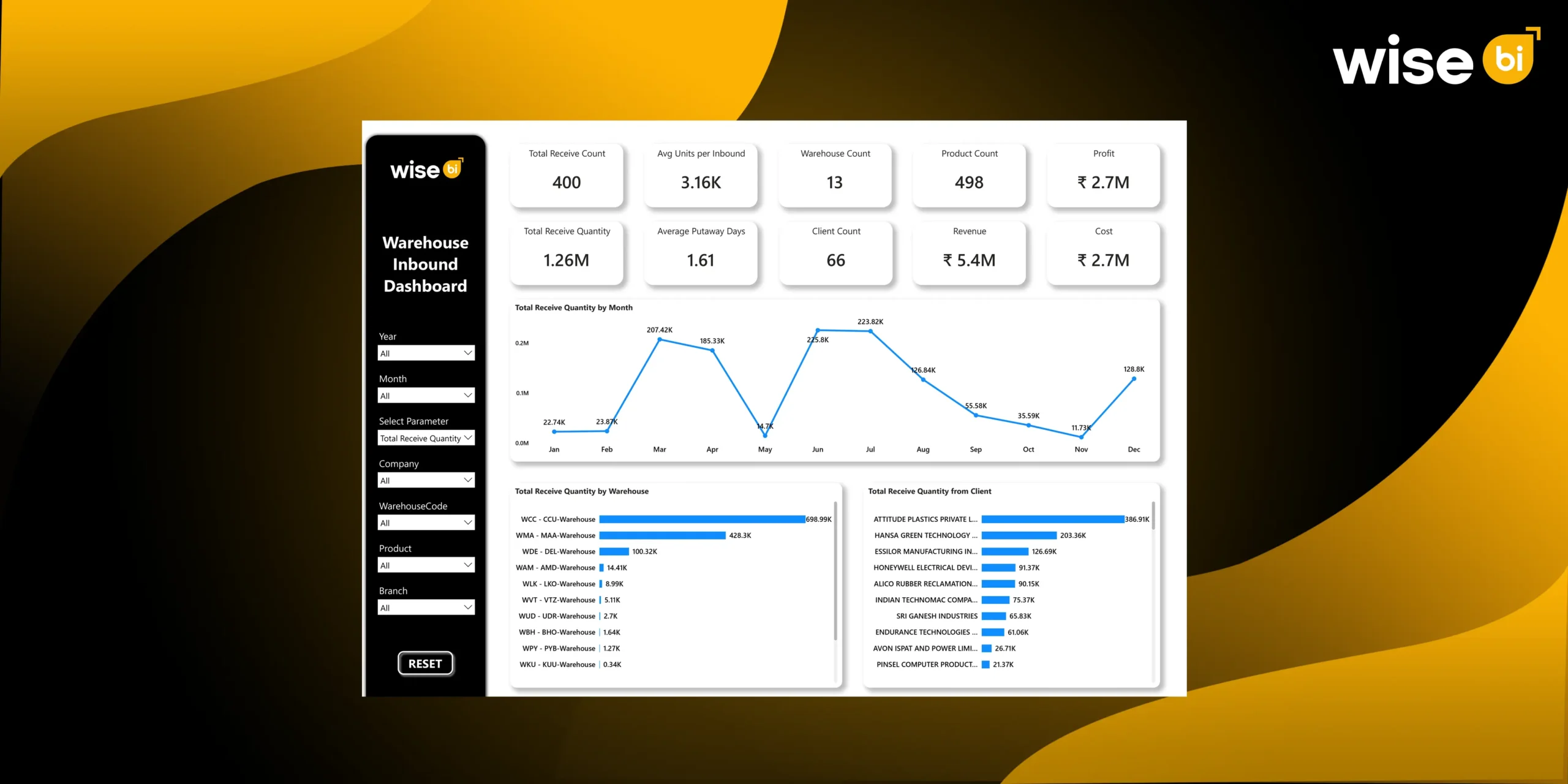
A CargoWise warehouse inbound dashboard is a data visualization and analytics interface that provides a consolidated view of all inbound warehouse activities across the CargoWise ecosystem. It transforms raw operational data, such as receipts, quantities, client shipments, and putaway timelines, into intuitive metrics, charts, and KPIs.
Instead of relying on spreadsheets or disconnected reports, warehouse managers can monitor:
- Total inbound shipments and received quantities
- Monthly and warehouse-wise inbound trends
- Product-level and client-level receipt distribution
- Putaway performance and processing timelines
- Financial metrics like revenue, cost, and profit are linked to inbound operations
Warehouse insights are critical for ensuring efficient warehouse operations because they have a direct impact on inventory accuracy, processing speed, and overall supply chain efficiency. Without clear visibility, warehouses frequently operate in a reactive manner, dealing with delays and inefficiencies as they arise. A properly configured CargoWise warehouse inbound dashboard enables teams to anticipate issues, allocate resources efficiently, and maintain a consistent operational flow.
Why is Inbound Visibility Critical in Warehouse Operations?
Inbound operations determine whether warehouse performance is set up for success or quietly set up for failure. When goods arrive without clear visibility, even a well-organized warehouse can quickly become inefficient.
The CargoWise warehouse inbound dashboard provides real-time information about what’s arriving, when it’s expected, where it should be processed, and how quickly it moves through receiving and putaway. Without it, decision-making slows, resources are inefficiently allocated, and operational bottlenecks become unavoidable.
Let’s break down why inbound visibility is absolutely critical.
Prevents Receiving Obstacles Before They Happen
One of the most common operational challenges is congestion at the receiving dock, especially when inbound shipments arrive in unpredictable waves. Without visibility, warehouses are forced into reactive handling, which leads to delays and inefficiencies.
- Visibility into inbound schedules enables planning of receiving activities
- Managers can allocate labor, dock doors, and material handling equipment based on expected volume
- Dock congestion, truck waiting time, and unloading delays are significantly reduced
By anticipating workload instead of reacting to it, warehouses maintain smoother inbound flow and higher throughput.
Improves Putaway Speed and Efficiency
Receiving goods is only one aspect of the inbound process; true efficiency is determined by how quickly those goods are moved into storage facilities. Delays in putaway cause floor congestion and disrupt downstream operations.
- Real-time tracking of putaway timelines highlights delays immediately
- Teams can identify process inefficiencies and optimize workflows
- Faster putaway improves space utilization and reduces staging area congestion
Efficient putaway ensures that inventory is immediately available for picking and fulfillment.
Strengthens Inventory Accuracy
Inbound is the first point at which warehouse inventory enters the system, making it critical for data integrity. Any errors at this stage are propagated throughout the inventory, fulfillment, and reporting processes.
- Real-time validation ensures received quantities match expected shipments
- Reduces manual entry errors through system-driven tracking
- Improves inventory accuracy and consistency across systems
Accurate inbound processing ensures consistent inventory visibility throughout the supply chain.
Enables Proactive Resource Planning
Without inbound visibility, workforce and resource planning become ineffective and inconsistent. Warehouses frequently experience either underutilization or operational overload.
- Historical and real-time inbound data support accurate workload forecasting
- Improved shift allocation leads to increased employee productivity
- Equipment and storage space can be prepared ahead of time
This leads to increased productivity, lower operational stress, and more efficient cost management.
Balances Workload Across Warehouses
In multi-warehouse environments, inbound volumes are often unevenly distributed, resulting in performance disparities between locations.
- Visibility into warehouse-level inbound activity highlights capacity gaps
- Enables redistribution of shipments or resources across facilities
- Prevents overloading high-volume warehouses while others remain underutilized
Balanced workload distribution improves network efficiency and operational stability.
Enhances Client Service and SLA Performance
Inbound delays have a direct impact on order processing timelines and customer commitments. It is difficult to maintain service level agreements when visibility is lacking.
- Enables prioritization of time-sensitive or high-value shipments
- Supports faster receiving and processing for key clients
- Improves adherence to SLAs and delivery timelines
Efficient inbound operations directly impact customer satisfaction and service reliability.
Provides Insight into Product Handling Requirements
Handling, storage conditions, and processing priorities vary depending on the product. A lack of visibility raises the risk of handling errors and inefficiencies.
- Product-level inbound visibility helps prepare appropriate storage and equipment
- Ensures compliance with handling requirements for sensitive or specialized goods
- Reduces errors and improves operational efficiency
Proper planning based on product data reduces risks while increasing handling accuracy.
Connects Operations with Financial Performance
Inbound operations directly impact warehouse profitability. Inefficiencies at this stage drive up costs and reduce overall performance.
- Delays in receiving and putaway increase labor and storage costs
- Inefficient workflows reduce throughput and productivity
- Visibility enables tracking of operational performance against financial outcomes
Improving inbound efficiency leads to better cost control and higher profits.
The CargoWise warehouse inbound dashboard is more than just tracking data; it’s about taking complete control of warehouse operations. It converts warehouses from reactive environments to highly efficient, performance-driven systems by allowing for real-time insights, proactive planning, and data-driven decisions.
How does a CargoWise Warehouse Inbound Dashboard Improve Warehouse Performance?
A CargoWise warehouse inbound dashboard improves performance by delivering real-time visibility, structured analytics, and actionable information. It allows warehouses to optimize processes, reduce delays, and increase overall efficiency.
Key improvements include:
- Real-time tracking of inbound shipments and received quantities
- Early identification of receiving and putaway bottlenecks
- Better utilization of warehouse space and resources
- Improved coordination between inbound and inventory processes
- Enhanced visibility into client and product-level performance
- Integration of financial metrics for profitability analysis
- Ability to compare performance across warehouses and time periods
- Faster response to demand fluctuations and seasonal trends
By transforming raw data into meaningful insights, the BI dashboard assists organizations in transitioning from reactive to proactive management.
What Makes Wise BI’s CargoWise Warehouse Inbound Dashboard Different?
Wise BI enhances CargoWise’s capabilities by providing advanced analytics and user-friendly visualizations tailored to warehouse operations. It elevates standard reporting to a dynamic, insight-driven experience.
Key differentiators include:
- Direct integration with CargoWise for accurate and real-time data
- Comprehensive KPI coverage across operational, performance, and financial areas
- Interactive filters and drill-down capabilities for deeper analysis
- User-friendly visual design that simplifies complex data
- Customizable BI dashboards aligned with specific business requirements
- Scalable solution suitable for growing warehouse operations
- Focus on actionable insights that drive continuous improvement
Wise BI’s CargoWise warehouse inbound dashboard provides organizations with not only visibility but also the ability to act on data effectively.
Conclusion
Manual tracking and fragmented data are no longer viable options for modern warehouse operations. With increasing shipment volumes, shorter delivery timelines, and more complex supply chains, real-time inbound visibility has become critical. A CargoWise warehouse inbound dashboard provides the information required to optimize inbound operations, reduce inefficiencies, and improve decision-making.
Do you want to see it in action? Schedule a free demo to see how the BI dashboard can enhance warehouse performance.