

Most of the businesses fail due to cash flow issues than due to a lack of profit.
Logistics and freight forwarding: this statement is more technical than it appears, and it is a practical reality. Even with strong revenue pipelines, inefficiencies in accounts receivable (AR) can limit liquidity, affect financial forecasting, and increase credit exposure.
To monitor receivables, most organizations use CargoWise’s standard reports or manual exports. However, these methods cause latency, data fragmentation, and limited analytical depth. As transaction volume increases, this approach becomes unsustainable. The CargoWise Invoice Payment Details Dashboard closes these gaps by adding a structured, real-time analytical layer to transactional data. Using data-driven insights, finance teams can monitor receivables performance, detect anomalies, and optimize collections.
What is the CargoWise Invoice Payment Details Dashboard?
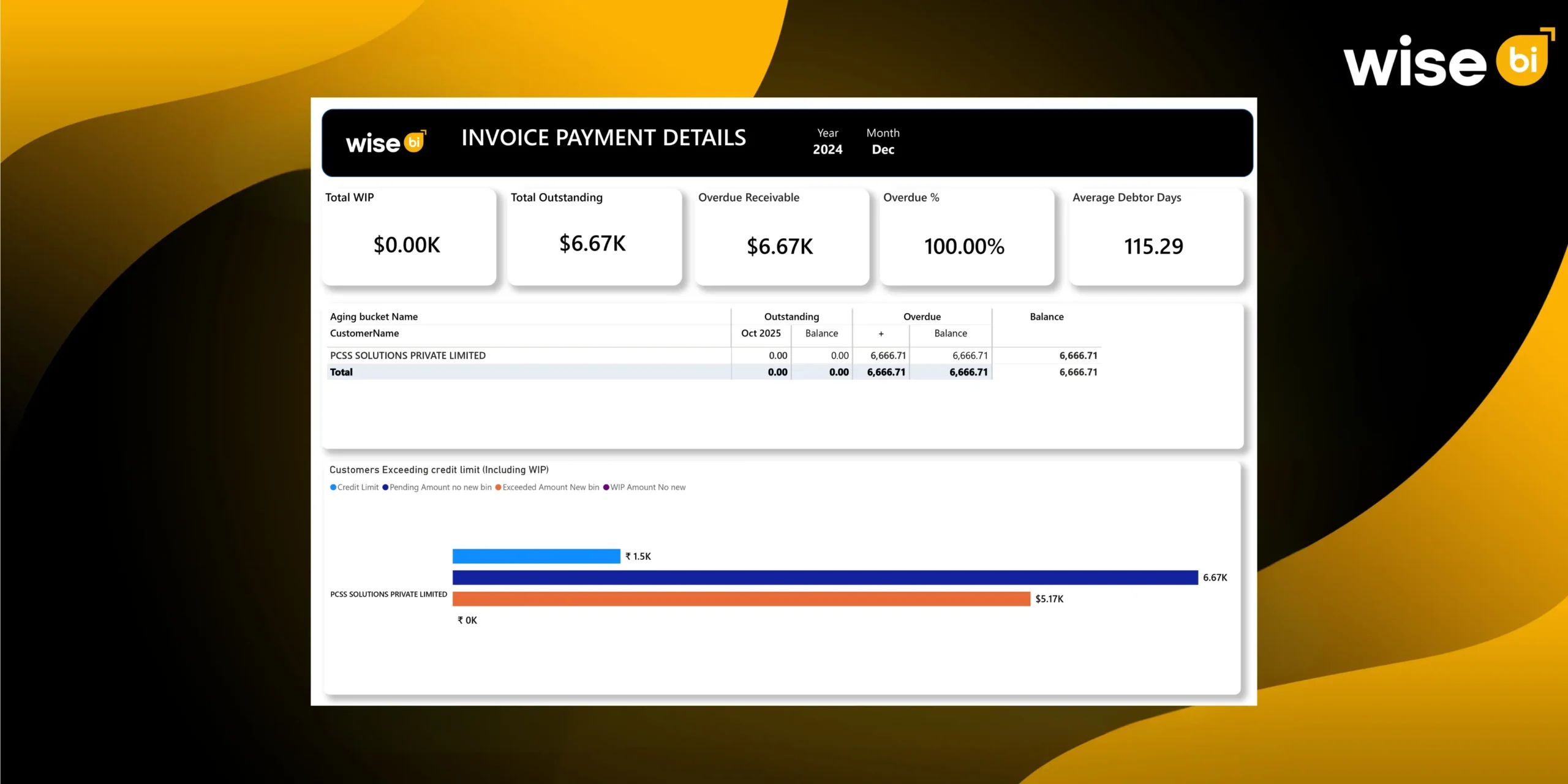
The CargoWise Invoice Payment Details Dashboard is a business intelligence-driven analytical framework built on top of CargoWise that aims to centralize, transform, and visualize invoice and payment data for accounts receivable management. It provides complete CargoWise data visibility, enabling finance teams to monitor, analyze, and manage receivables more efficiently.
Think of it as your financial control tower. Instead of jumping between reports or manually compiling data, everything you need is presented in one clean, interactive view. This makes it a powerful accounts receivable dashboard for logistics companies looking to gain real-time control.
Here is what it brings together:
- A complete overview of invoice statuses: paid, pending, and overdue
- Total outstanding and overdue receivables at a glance
- Customer-wise breakdown of payments and balances
- Aging insights to understand how long invoices remain unpaid
- Credit limit tracking to monitor customer exposure
The real advantage is that you are not just looking at numbers; you are understanding the story behind them. You can quickly identify which customers consistently delay payments, which invoices require immediate attention, and where your financial risks are building up.
Limitations of Traditional Accounts Receivable Processes
Traditional accounts receivable (AR) processes in logistics frequently struggle to keep up with the complexity and speed of contemporary operations. While systems like CargoWise provide core transactional capabilities, many organizations continue to rely on outdated workflows layered on top, resulting in inefficiencies, delays, and financial gaps.
As transaction volumes and customer credit exposure rise, these gaps become more visible at the technical and operational levels.
Lack of Real-Time Data Visibility
One of the most significant limitations is delayed access to financial data.
- Reports are often generated periodically (daily, weekly, or monthly)
- No immediate visibility into overdue invoices or outstanding balances
- Delayed insights lead to late follow-ups and missed collection opportunities
Without real-time integration, AR teams are always working with historical data rather than current financial information.
Fragmented Data Across Systems
In many cases, AR data is not centralized and must be gathered from multiple sources.
- Invoice data, payment records, and credit limits exist in separate views
- Manual consolidation is required to create a complete picture
- Inconsistencies arise due to mismatched or outdated data
This fragmentation lowers data reliability and slows decision-making.
Heavy Dependence on Manual Processes
Traditional AR workflows are heavily reliant on spreadsheets and manual intervention.
- Data extraction, cleaning, and reporting require significant effort
- High risk of human errors in calculations and reconciliation
- Time spent on reporting reduces the time available for collections
As data volume increases, manual processes become more inefficient and unsustainable, especially without a scalable CargoWise reporting solution.
Inefficient Collections and Follow-Ups
Without structured prioritization, collections tend to be reactive rather than strategic.
- No clear identification of high-value or high-risk overdue invoices
- Follow-ups are delayed or inconsistent
- Teams lack visibility into which customers require immediate attention
This leads to longer payment cycles and more debtor days.
Limited Credit Risk Monitoring
Traditional reports frequently fail to include proactive credit control mechanisms.
- Customers exceeding credit limits are not flagged in real time
- No consolidated view of exposure, including outstanding and WIP
- Increased risk of over-crediting high-risk customers
This lack of visibility has a direct impact on financial stability and risk management.
No Advanced Analytics or Predictive Insights
Standard AR reporting prioritizes historical data over actionable insights.
- No analysis of customer payment behavior trends
- Limited ability to forecast cash flow accurately
- No early warning signals for potential payment delays
As a result, organizations operate reactively rather than using predictive intelligence.
Scalability Challenges
As businesses grow, traditional AR processes fail to scale effectively.
- Increasing transaction volumes slow down reporting
- Manual workflows become bottlenecks
- Data complexity exceeds the capabilities of basic reporting tools
This creates operational strain and limits the organization’s ability to maintain financial control.
Traditional AR processes are ineffective because they are static, manual, and fragmented, whereas modern logistics operations require real-time invoice tracking with CargoWise, automation, and insight-driven systems.
How the CargoWise Invoice Payment Details Dashboard Improves Accounts Receivable
Managing accounts receivable efficiently requires more than just tracking invoices; it demands real-time visibility, structured data processing, and actionable insights. The Wise BI’s CargoWise Invoice Payment Details Dashboard enhances AR performance by introducing a data-driven layer over transactional systems like CargoWise.
Real-Time Data Visibility and Synchronization
The BI dashboard integrates directly with CargoWise data sources, ensuring continuous updates of receivables data.
- Provides live tracking of outstanding and overdue invoices
- Eliminates delays caused by periodic report generation
- Ensures all stakeholders have access to the same up-to-date financial data
This real-time visibility allows teams to detect issues early and respond immediately, rather than reacting after delays occur.
Intelligent Collections Prioritization
Collections become more efficient when driven by structured insights rather than manual labor.
- Identifies high-value and high-risk overdue invoices
- Enables prioritization based on aging, amount, and customer risk
- Supports targeted follow-ups instead of generic collection efforts
This improves recovery rates while reducing time spent on low-impact activities.
Reduction in Debtor Days
The average debtor days are an important AR performance indicator, and the BI dashboard directly contributes to their optimization.
- Tracks payment timelines across customers and invoices
- Highlights delays at an early stage
- Enables proactive intervention before invoices become critically overdue
By improving visibility and follow-up timing, businesses can shorten the cash conversion cycle.
Advanced Credit Risk Monitoring
Real-time insights tracking greatly improves credit control.
- Monitors customers exceeding credit limits instantly
- Combines outstanding balances with WIP for accurate exposure calculation
- Flags high-risk accounts for immediate action
This prevents over-crediting and helps maintain financial stability and controlled risk exposure.
Actionable Analytics and Financial Insights
The BI dashboard transforms raw transactional data into meaningful insights that support decision-making.
- Assesses customer analysis, behavior, and trends.
- Provides aging distribution across receivables
- Identifies revenue at risk due to overdue invoices
These insights enable finance teams to move from descriptive reporting to strategic financial planning.
Automation and Process Standardization
Manual AR processes are replaced with automated workflows and standardized logic.
- Automates data extraction, transformation, and visualization
- Reduces dependency on spreadsheets and manual reconciliation
- Ensures consistent KPI calculations across teams
This improves accuracy, reduces operational workload, and enhances overall efficiency.
Scalability and Performance Optimization
As transaction volumes grow, the BI dashboard maintains performance and usability.
- Handles large datasets without performance degradation
- Supports multi-dimensional analysis (customer, region, aging bucket)
- Adapts to business growth without requiring process redesign
This ensures that AR processes are both efficient and scalable over time. Businesses can improve their financial control and operational efficiency by transitioning from manual, reactive workflows to a proactive, data-driven approach.
Conclusion
A data-driven logistics landscape based on out-of-date AR processes can be detrimental to your company. The CargoWise Invoice Payment Details Dashboard gives you the visibility, control, and intelligence you need to stay ahead, allowing you to improve collections, reduce financial risk, and maintain consistent cash flow.Are you ready to take control of your accounts receivable and gain real-time financial insight? Schedule a free demo today with us to see how the BI dashboard can help you improve your receivables process and achieve measurable results.