

Logistics is a high-volume, credit-driven industry in which cash outflows precede cash inflows. Companies pay carriers, terminals, and service partners right away to keep cargo moving, but customer payments often come weeks or months later. The gap between service delivery and revenue realization causes financial strain. Without disciplined receivables control, businesses risk increasing revenue while reducing cash position.
A debtor dashboard is especially useful in this situation. It moves receivables management from reactive reporting to proactive financial control, giving decision-makers real-time visibility into who owes money, how long it’s been outstanding, and where financial risk is increasing. Rather than waiting for month-end summaries, management gets daily updates on cash exposure and collection performance.
What is a Debtor Dashboard?
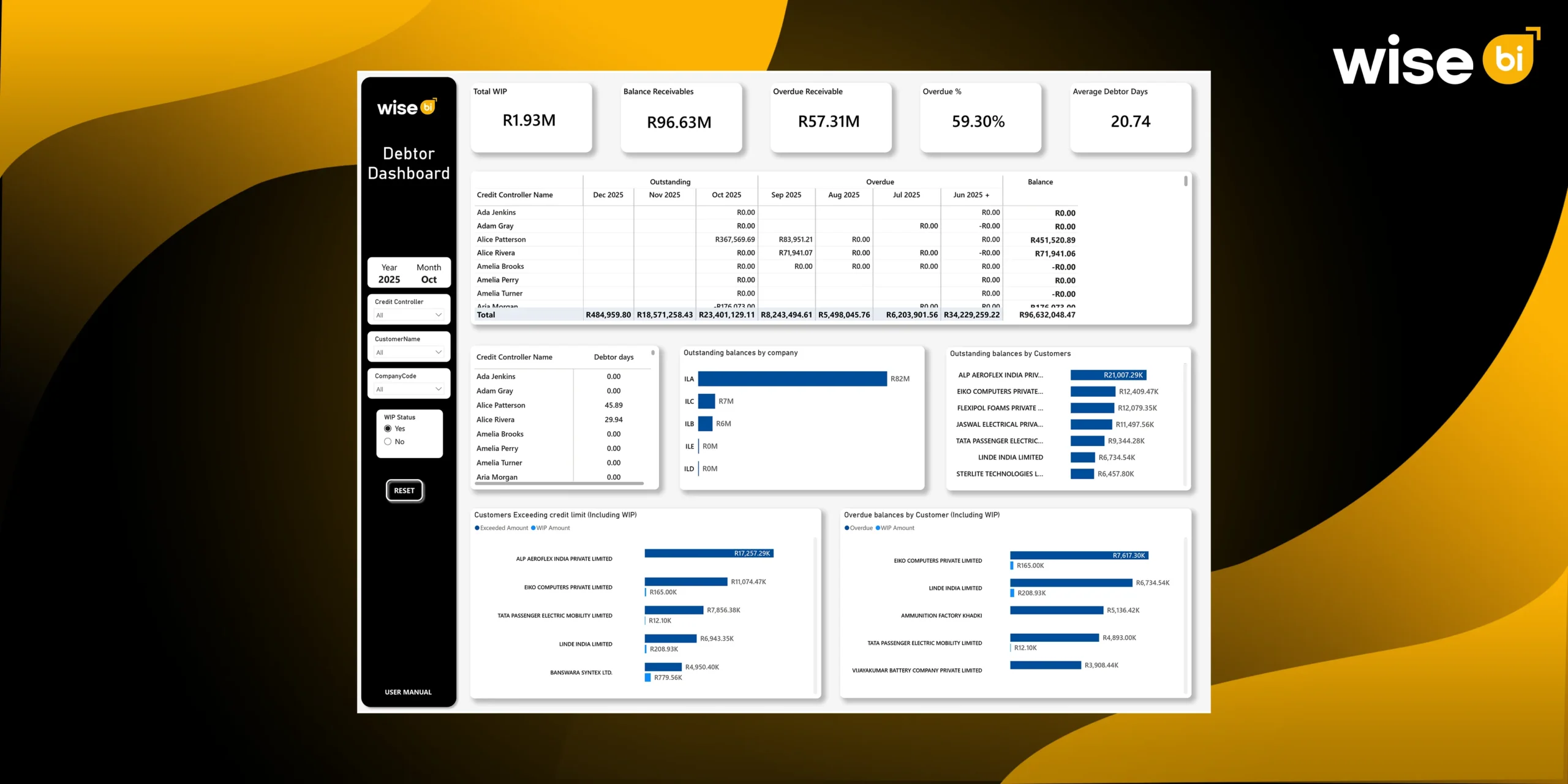
A debtor dashboard is a structured financial intelligence tool that provides complete, real-time visibility into a company’s accounts receivable. Instead of relying on multiple aging reports, spreadsheets, or static summaries, it consolidates all critical receivables data into a single analytical interface.
This level of visibility is especially important for logistics and freight forwarding companies using ERP systems like CargoWise, SAP, and GoFreight. In an industry where margins are tight and credit exposure rises with shipment volume, maintaining liquidity and financial stability necessitates structured, real-time receivables management.
- Total outstanding invoices
- Overdue balances
- Aging distribution (current, short-term overdue, long-term overdue)
- Average debtor days (DSO)
- Customer-level exposure
- Credit limit utilization
- Collection performance trends
By presenting this information through key performance indicator tiles, charts, trend lines, and drill-through reports, the dashboard eliminates manual reconciliation and reduces dependency on fragmented reports.
Simply put, it answers one critical question: How much money are customers yet to pay, and how efficiently are we collecting it?
Why is Cash Flow a Challenge in Logistics Operations?
To understand the value of a debtor dashboard, it is important to first examine why cash flow management is particularly complex in logistics businesses.
High Upfront Operational Costs
In logistics operations, cash outflow begins the moment shipment execution starts. Freight forwarders must pay carriers, ports, customs authorities, transporters, and warehouse providers to ensure cargo movement without delays. These payments are operationally mandatory and strictly time-bound.
Typical upfront costs include:
- Ocean freight and air freight
- Terminal Handling Charges (THC)
- Port dues and container yard handling fees
- Customs duties and clearance charges
- Inland transportation and delivery expenses
- Warehousing, demurrage, and detention costs
Because these expenses are tied to vessel schedules, customs clearance timelines, and cargo release requirements, logistics companies must disburse cash immediately, often before collecting payment from customers. This creates immediate working capital pressure.
Credit-Based Customer Relationships
Offering credit terms is a standard commercial practice in the logistics industry. To remain competitive and retain clients, freight forwarders commonly extend structured payment cycles.
Typical credit arrangements include:
- 30-day payment terms
- 45–60 day commercial agreements
- 90-day extended credit for strategic accounts
- Rolling credit limits linked to shipment volume
While these credit structures support business as shipment volume increases, cash realization takes longer. The credit exposure increases proportionally. This results in a higher Days Sales Outstanding (DSO) and continued pressure on working capital.
Delayed Invoicing and Billing Inefficiencies
In logistics, invoicing depends on shipment documentation, rate confirmation, and job closure in ERP systems. Any delay in these processes postpones billing and extends the cash conversion cycle.
Common causes of invoicing delays include:
- Pending Bill of Lading (BL) or Air Waybill (AWB) confirmation
- Rate disputes or pricing mismatches
- Incomplete job costing in ERP systems
- Manual consolidation of shipment charges
- Delayed internal approvals
Since invoicing triggers the credit cycle, even small inefficiencies push the entire payment timeline forward, slowing cash inflow.
Multi-Branch and Multi-Entity Complexity
Many logistics companies operate across multiple branches, legal entities, and trade corridors. This decentralized structure complicates receivables tracking.
Operational complexity often includes:
- Regional branch offices
- Separate legal entities
- Multi-currency billing environments
- Intercompany allocations
Without centralized visibility, exposure can accumulate unnoticed across locations. Overdue balances may increase, and credit limits may be exceeded without timely intervention.
Rising Overdue Receivables
When collections are not actively monitored and prioritized, overdue balances can escalate quickly. Aging buckets tend to decline over time.
- 0–30 days: Current
- 31–60 days: Early overdue
- 61–90 days: High-risk zone
- 90+ days: Critical recovery stage
As invoices age, the probability of recovery decreases. Increasing overdue percentages directly impacts liquidity and undermines financial stability.
Work in Progress (WIP) Exposure
Logistics revenue may be operationally completed but not invoiced due to documentation gaps or pending confirmations, resulting in unaccounted-for financial exposure.
WIP exposure may arise from:
- Jobs completed but pending billing
- Charges awaiting cost confirmation
- Shipment closure delays in ERP systems
- Disputed job costing
Because WIP is not immediately converted into receivables, it extends the order-to-cash cycle and increases overall working capital requirements.
How does a Debtor Dashboard Improve Cash Flow?
A Wise BI debtor dashboard shifts receivables management from reactive tracking to proactive financial control. Here’s how it directly strengthens cash flow:
Real-Time Financial Visibility
The BI dashboard provides a centralized, live view of receivables across customers, branches, and entities. Instead of waiting for month-end reports, management can monitor exposure daily.
It enables visibility into:
- Total outstanding receivables
- Overdue balances
- Aging bucket distribution
- Debtor Days (DSO)
- Customer-wise and branch-wise exposure
With real-time updates, risks are identified early, enabling timely corrective action before overdue balances escalate.
Faster and Prioritized Collections
Structured visibility allows credit controllers to focus on high-risk accounts rather than chasing all invoices equally.
The BI dashboard helps prioritize:
- 60+ and 90+ day overdue invoices
- High-value outstanding customers
- Accounts nearing credit limits
- Customers with repeated payment delays
By targeting high-risk receivables first, collection efficiency improves, and DSO reduces, accelerating cash inflow.
Proactive Credit Limit Monitoring
One of the strongest advantages of a Debtor Dashboard is proactive credit risk control.
It highlights:
- Customers exceeding approved credit limits
- Total exceeded exposure (including WIP)
- Rising overdue percentages
- Concentration of risk by account
This enables management to:
- Place accounts on credit hold
- Restrict further job creation
- Revise payment terms
- Request advance or partial payments
Early intervention prevents exposure from increasing and protects working capital.
Improved Working Capital Planning
Accurate receivable insights allow finance teams to forecast incoming cash more reliably.
The BI dashboard supports:
- Trend analysis of collections
- Monitoring DSO movement
- Entity-level cash inflow projections
- WIP-to-invoice conversion tracking
This strengthens liquidity planning and reduces dependency on short-term borrowing.
Better WIP Conversion Control
Unbilled revenue significantly impacts the cash conversion cycle. The Wise BI debtor dashboard provides clear visibility into WIP exposure.
It helps track:
- Jobs pending invoicing
- Aging WIP amounts
- Operational bottlenecks affecting billing
- Combined exposure (AR + WIP)
By accelerating billing cycles, companies shorten the order-to-cash process and improve revenue realization speed.
Enhanced Accountability and Performance Tracking
The debtor dashboard also strengthens internal discipline by measuring collection performance.
It enables tracking of:
- Controller-wise debtor days
- Overdue percentage by branch
- Collection performance trends
- Follow-up effectiveness
Clear accountability improves team performance and ensures consistent receivables control.
The Result: Stronger and More Predictable Cash Flow
By combining real-time visibility, structured collections, credit monitoring, and WIP control, the Wise BI debtor dashboard helps logistics companies:
- Reduce Days Sales Outstanding (DSO)
- Lower overdue percentages
- Improve cash conversion cycle
- Control credit exposure
- Strengthen working capital position
In a high-volume, credit-driven industry like logistics, receivables visibility is not just a reporting feature; it is a strategic financial control mechanism.
Conclusion
Finally, revenue growth alone does not ensure financial stability. Structured receivables management works. A debtor dashboard provides real-time visibility into outstanding balances, overdue invoices, credit exposure, and work-in-progress, allowing for faster collections and better working capital control.
Improved transparency and proactive decision-making make cash flow more predictable, managed, and sustainable. Schedule a free demo with us today to see how a debtor dashboard can change your cash flow management.