


Every day, logistics teams using CargoWise process hundreds of outbound orders, picking, packing, dispatching, and tracking shipments across multiple locations.
But here’s the catch: even with all that data sitting inside CargoWise, many businesses still struggle with delayed shipments, last-minute cancellations, and inconsistent warehouse performance.
Sound familiar?
It’s not because CargoWise lacks capability. It’s because data visibility and decision-making are not fully optimized.
In this blog, you’ll learn how to transform your CargoWise warehouse operations from reactive and stressful into structured, efficient, and predictable, using the data you already have.
Understanding the Complexity Behind CargoWise Warehouse Outbound Operations
Warehouse outbound operations are not a single task; it’s a chain of interdependent processes. It involves multiple connected steps:
- Order creation and validation
- Inventory allocation
- Picking and packing
- Dispatch planning
- Shipment execution
- Delivery tracking
On paper, it looks smooth. But in reality, each step involves multiple teams, systems, and decisions.
Now add:
- Multiple warehouses
- Different product types
- Client-specific requirements
Suddenly, operations become complex.
While CargoWise captures all this data efficiently, most teams only access it through reports, making it difficult to act in real time.
The Real Problem: Data Exists, But Visibility Doesn’t
CargoWise is one of the most powerful cloud-based ERPs in the logistics space. It does an excellent job of capturing operational data, managing shipments, and structuring workflows across forwarding, warehousing, and finance.
But here’s the reality most operations teams quietly deal with:
Having data doesn’t automatically mean having clarity.
That is where the gap begins.
Static Reports Slow Down Decision-Making
CargoWise generates reports, but most of them are static snapshots.
You pull a report, review it, potentially export it, and try to figure out what’s going on. But once you’ve gone through all that:
- The delay has already happened
- The shipment is already late
- The customer has already followed up
Decisions in fast-paced warehouse environments must be made in minutes, rather than hours or days.
Static reporting cannot keep up with such a rapid pace.
No Real-Time Operational Visibility
One of the biggest challenges is the lack of a live, unified view of outbound operations.
You might know:
- Total orders processed
- Shipment statuses
- Warehouse activity
But you don’t instantly see:
- Which orders are currently at risk?
- Which warehouse is falling behind today?
- Where is the roadblock currently forming?
As a result, teams react after problems occur instead of preventing them.
Difficult to Compare Warehouse Performance
If you manage multiple warehouses, this becomes even more challenging.
Although CargoWise stores the data, comparing performance across locations often requires:
- Pull multiple reports
- Filter data manually
- Cross-check information
Even then, insights are not always clear.
This makes it difficult to answer critical questions:
- Which warehouse is consistently underperforming?
- Which one handles high-volume orders better?
- Where should you focus on improvements first?
Without clear comparisons, standardizing warehouse performance becomes a challenge.
Limited Drill-Down for Quick Root Cause Analysis
Identifying a delay is only the first step.
Understanding why it happened often requires manual investigation:
Now what?
In many cases, you’ll need to dig deeper, manually, to find:
- Which order caused the issue?
- What stage has it become stuck in?
- Is it a recurring pattern?
This process is time-consuming.
What teams really need is the ability to move from a high-level view directly to order-level details, instantly.
Move from a high-level view → straight into order-level details instantly
Without that, root cause analysis remains slow and inefficient.
Disconnected Data Across Functions
Warehouse outbound operations don’t exist in isolation.
They’re connected to:
- Warehouse teams
- Transport planning
- Customer requirements
- Inventory availability
While CargoWise captures all this data, it often exists in separate layers.
This leads to siloed workflows:
- Warehouse focuses on dispatch
- Operations focuses on shipments
- Management looks at reports
But no one has a single, connected view of everything happening together.
The result:
- Misaligned decisions
- Delays in coordination
- Missed opportunities to optimize
Heavy Dependence on Manual Follow-Ups
Due to limited data visibility in CargoWise reports, teams rely heavily on:
- Emails
- Phone calls
- Internal messages
- Excel tracking
Instead of the system guiding decisions, people are looking for updates.
This not only slows things down but also raises the possibility of:
- Errors
- Miscommunication
- Missed deadlines
Over time, it creates operational fatigue.
It’s Not a System Problem; It’s a Data Visibility Gap
Here’s the key takeaway: CargoWise is not the problem.
It is doing exactly what it was intended to do: collect and manage data.
The real challenge is converting that data into clear, real-time, actionable insights.
Without that level of CargoWise data visibility:
- You react instead of planning
- You fix problems instead of preventing them
- You rely on effort instead of intelligence
That’s why most freight forwarders, even when using a powerful system like CargoWise, reach a logistics BI solution.
How does a Warehouse Outbound Dashboard Improve CargoWise Operations?
Data is stored in CargoWise, and a business intelligence dashboard will bring it to life.
Most logistics teams don’t struggle due to a lack of data. They struggle because they can’t:
- See it clearly
- Connect it quickly
- Act on it confidently
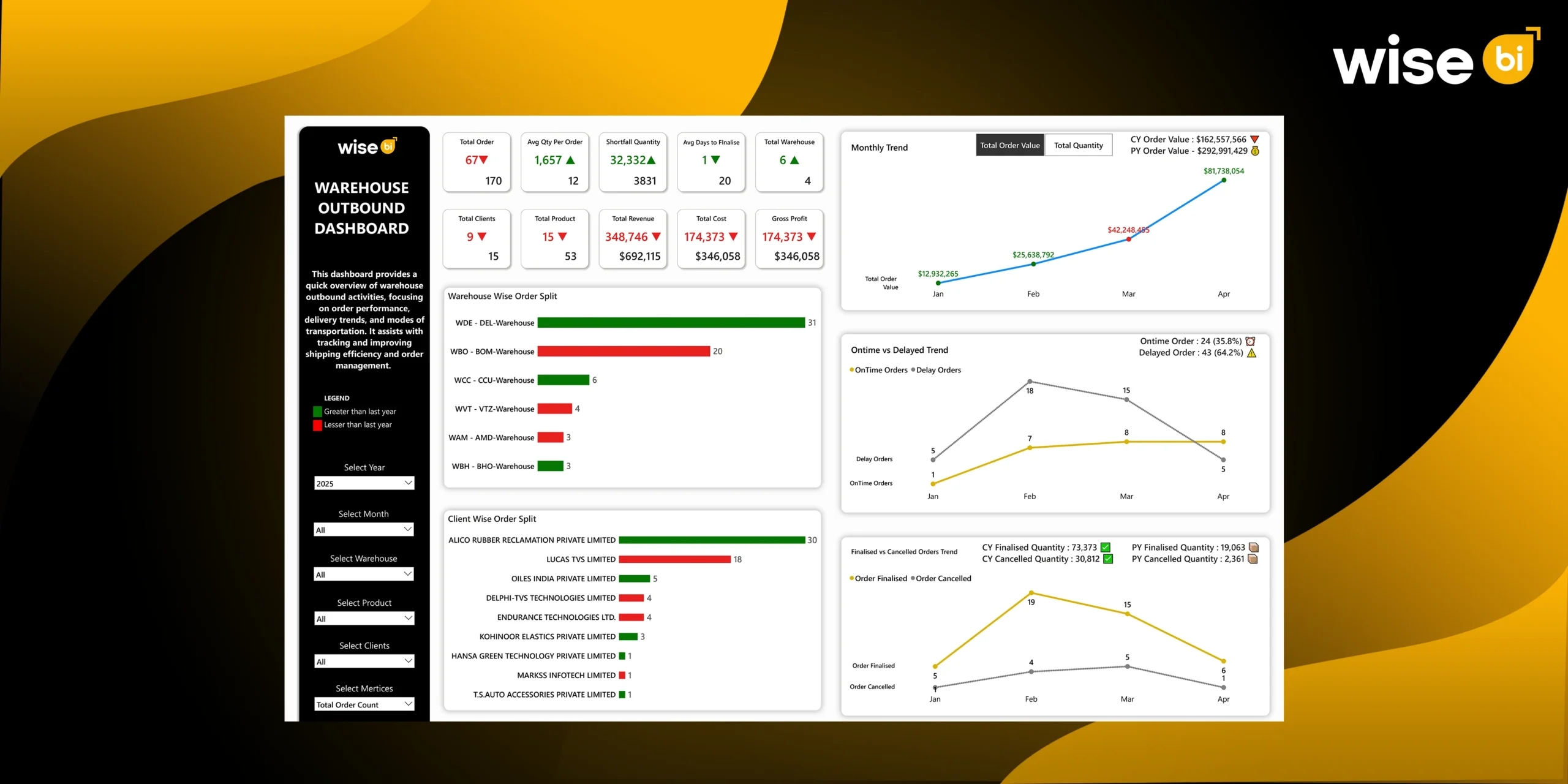
That is where Wise BI’s Warehouse Outbound dashboard comes in and changes the game.
From Static Reports to Real-Time Visibility
Instead of pulling reports at the end of the day (or worse, the end of the week), the BI dashboard gives you a live view of your warehouse outbound operations.
You don’t have to guess what’s happening; you can see it instantly:
- Orders that are moving smoothly
- Shipments that are at risk
- Warehouses that are falling behind
This shift alone changes everything.
You go from
“What went wrong?”
to
“What needs attention right now?”
By closing reporting gaps in logistics operations, CargoWise BI dashboards transform reactive workflows into proactive control.
Turning Complex Data into Simple Visual Insights
To be honest, spreadsheets and long reports can be overwhelming.
The BI dashboard breaks it down into clear, visual insights:
- Trends that show performance over time
- Comparisons between warehouses
- Patterns in delays, cancellations, or product movement
Instead of sifting through rows of data, you can identify issues in seconds.
Instant Drill-Down to the Root Cause
One of the most significant benefits of the BI dashboard is the ability to quickly shift from a broad overview to the specifics that matter.
Assume you’ve noticed an increase in delayed orders.
Using the BI dashboard, you can immediately
- Drill down into specific warehouses
- Identify affected clients
- Pinpoint the exact orders causing the issue
No back-and-forth. There is no manual digging.
This kind of speed is essential in logistics, where every delay has a knock-on effect.
Connecting Data Across Your Entire Operation
The BI dashboard brings together:
- Warehouse performance
- Client behavior
- Product demand
- Order lifecycle stages
Instead of isolated data points, you gain a connected, end-to-end view.
You begin to understand:
- How does warehouse performance affect delivery timelines?
- How specific clients influence operational load.
- How does product movement affect efficiency?
That is when data stops being fragmented and starts telling a complete story.
Empowering Faster, Smarter Decisions
When CargoWise data visibility improves, decision-making naturally strengthens.
Using a business intelligence dashboard, you can
- Act on delays before they escalate
- Allocate resources more effectively
- Adjust workflows based on real-time insights
- Prioritize high-impact actions
The best part?
You don’t have to wait for reports or rely on assumptions.
You make decisions based on what is happening now, not what happened yesterday.
Reducing Manual Effort and Operational Stress
Think about how much time your teams currently spend:
- Chasing updates
- Sending emails
- Asking for status confirmations
- Updating spreadsheets
The BI dashboard eliminates much of this effort.
Instead of chasing information, it comes to you, clearly and immediately.
This leads to:
- Less manual effort
- Fewer errors
- Better team productivity
- Reduced operational stress
Let’s be honest: that is something that any logistics team can embrace.
The Real Shift: From Data to Control
The biggest benefit of a BI dashboard isn’t better reporting; it’s better control.
You go from:
- Limited visibility → Full transparency
- Delayed reactions → Proactive decisions
- Disconnected data → Unified insights
Once you achieve that level of control, your warehouse outbound operations not only improve but also become more predictable, scalable, and manageable.
Conclusion
Optimizing warehouse outbound operations in CargoWise does not entail adding new tools or changing your current workflow.
It’s about using your data in a more intelligent, connected manner.
Today, most challenges, delays, inefficiencies, and constant follow-ups don’t come from system limitations. They result from a lack of real-time data visibility and the inability to act at the right moment. Book a free demo with Wise BI today and turn your CargoWise warehouse outbound data into actionable insights.