


Everything seems fine until it doesn’t.
Shipments move, invoices are sent, and everything appears to be on track until payments are delayed. Follow-ups increase, visibility decreases, and uncertainty about incoming cash begins to grow. The issue is not performance; it is a lack of real-time visibility into receivables. By the time teams identify what needs to be addressed, time and cash flow have already been impacted.
In this blog, we’ll break down the key KPIs you should track in a CargoWise Invoice Payment Dashboard to improve cash flow and gain better control over your receivables.
Before That: Why are CargoWise Invoice Reports Not Enough for Cash Flow Visibility?
CargoWise provides robust financial tracking capabilities, particularly for invoices, receivables, and payment records. Standard invoice payment reports, on the other hand, can be insufficient for day-to-day decision-making and cash flow control.
These limitations don’t come from a lack of data but from how that data is presented and used.
Static Reports Don’t Support Real-Time Decisions
CargoWise Invoice Payment Reports display historical data rather than real-time information. This causes delays in identifying payment issues and forces teams to react rather than act proactively.
Limited Visibility Across Receivables
Data is displayed in multiple views, making it difficult to understand the overall cash flow picture or prioritize which invoices require attention.
Difficult to Identify Risks Quickly
Spotting risks like delayed payments or credit overuse requires manual effort, which slows down detection and increases financial exposure.
No Instant Drill-Down for Root Cause Analysis
Reports highlight issues but don’t quickly reveal the cause, making it time-consuming to identify affected customers or invoices.
Heavy Dependence on Manual Follow-Ups
Teams rely on emails, calls, and spreadsheets to track payments, increasing workload and the risk of missed updates.
Limited Support for Proactive Cash Flow Management
Reports are useful for reviewing past performance, but they do not provide early warnings, resulting in reactive decisions and unpredictable cash flow.
The Bottom Line
CargoWise invoice payment reports are useful, but they do not always provide the clarity needed to make quick, confident decisions.
The challenge isn’t access to information but the ability to;
- See the full picture
- Identify issues early
- Act at the right time
That’s when logistics companies start looking beyond reports for KPI-driven visibility and more intelligent financial insights.
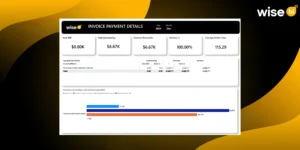
The KPIs You Should Track with CargoWise Invoice Payments Details Dashboard
Understanding the right KPIs in your CargoWise Invoice Payment Dashboard is critical to improving cash flow. These metrics reveal not only your company’s financial status, but also how effectively it manages receivables, collections, and credit risk.
Total Outstanding Amount
The total outstanding amount reflects the total value of unpaid invoices at any given time. It provides a clear picture of how much revenue is still outstanding. When this number increases consistently, it often indicates delays in collections or inefficiencies in follow-up processes.
This KPI helps you understand:
- How much cash is currently in receivables?
- Does your collection cycle seem to be slowing down?
- What is the overall pressure on your working capital?
Overdue Receivables
Overdue receivables highlight invoices that have passed their due date and are still unpaid. This is one of the most critical indicators of financial health, as it directly reflects collection performance and customer payment behavior.
Tracking overdue receivables helps you:
- Identify delays in customer payments
- Understand risks in your receivables
- Monitor the effectiveness of your collection process
Overdue Percentage
The overdue percentage shows how much of your total outstanding amount is overdue. Instead of just looking at values, this KPI gives you a clearer sense of how much of your receivables are at risk.
This KPI provides insight into:
- The overall quality of your receivables
- Payment discipline across customers
- Whether your cash flow is stable or under stress
Average Debtor Days
Average debtor days measure how long it takes for customers to pay their invoices. It reflects the speed at which your business converts sales into actual cash.
This KPI helps you evaluate:
- The efficiency of your credit terms
- Customer payment habits
- The overall cash flow cycle of your business
Aging of Receivables (Aging Buckets)
Aging buckets categorize receivables based on how long invoices have been outstanding. This allows you to prioritize collections based on urgency and risk.
With aging analysis, you can:
- Identify older invoices that need immediate attention
- Understand how receivables are distributed across time periods
- Prevent long-pending invoices from turning into bad debts
Customer-Level Outstanding and Overdue
This KPI breaks down receivables at the customer level, giving you visibility into who owes how much and who is consistently delaying payments.
It helps you:
- Identify high-risk customers
- Focus collection efforts on key accounts
- Manage customer-specific payment behavior effectively
Customers Exceeding Credit Limits
This metric highlights customers whose outstanding balances have exceeded their approved credit limits. It signals potential financial exposure and risk.
Tracking this KPI allows you to:
- Monitor customers who are over-utilizing credit
- Control financial risk more effectively
- Ensure credit policies are being followed
Pending Amount vs Credit Limit
This KPI compares a customer’s current outstanding balance with their credit limit. It provides a real-time view of how close a customer is to exceeding their credit capacity.
It helps in:
- Identifying early warning signs of risk
- Maintaining better control over credit exposure
- Supporting informed decision-making on future transactions
Work in Progress (WIP)
“Work in progress” refers to transactions that are not yet invoiced. While it may seem operational, it directly impacts cash flow because unbilled work cannot be collected.
Monitoring WIP helps you:
- Ensure timely invoicing
- Reduce delays in revenue realization
- Improve the overall cash conversion cycle
Tracking these KPIs isn’t just about monitoring numbers; it’s about understanding how money moves through your business.
When these metrics are viewed together, they provide a clear picture of:
- Where cash is getting delayed
- Which customers require attention
- How efficiently receivables are being converted into cash
This level of visibility allows finance teams to move from chasing payments to managing cash flow with clarity and confidence.
Finally, the right KPIs elevate your CargoWise Invoice Payment Dashboard beyond a reporting tool, transforming it into a practical system for financial control and smarter decision-making.
Conclusion
Managing cash flow is more than just tracking invoices; it’s also about understanding how quickly those invoices become actual payments.
CargoWise provides the data required to monitor receivables, but relying solely on reports reduces visibility and delays action.
If you’re still using static reports and manual tracking, you’re only seeing a portion of the picture. It is time to convert your CargoWise invoice data into real-time, KPI-driven insights. Schedule a free demo with Wise BI today and see how you can transform your CargoWise invoice data into complete cash flow control.