



Your freight forwarding company can handle thousands of shipments, generate millions in revenue, and still struggle to answer one critical question: Where is the money actually going?
For CFOs, financial visibility goes beyond revenue reports and balance sheets. It means understanding which shipments generate profit, which customers delay payments, and how rising operational costs affect the bottom line.
Yet these answers are often scattered across CargoWise reports, financial records, and spreadsheets, making it difficult to see the complete financial picture.
This is where AI-powered business intelligence changes the way logistics CFOs work. By connecting operational and financial insights, AI helps finance leaders identify risks, uncover profitability trends, and make informed decisions with greater confidence.
Why is Financial Visibility Challenging for Logistics CFOs?
Freight forwarding and supply chain businesses manage financial transactions across customers, carriers, shipments, branches, departments, and currencies.
A single shipment may involve multiple revenue and cost components, while customer payments and supplier settlements follow different timelines.
As operations expand, CFOs need to understand not only what the company earns but also where profits are generated, which customers affect working capital, and how financial performance differs across business units.
Traditional reporting processes can make these questions difficult to answer quickly.
Finance teams may export CargoWise information into spreadsheets, reconcile figures, and prepare separate reports for management. By the time these reports are reviewed, the underlying business position may have changed.
AI-powered BI helps reduce this reporting burden by making connected financial information easier to access, compare, and analyze.
What is AI-Powered Business Intelligence for Logistics Finance?
AI-powered business intelligence combines financial reporting, data visualization, and AI-assisted analysis to help finance teams understand business performance.
Business intelligence displays established financial KPIs, including revenue, gross profit, receivables, and customer performance.
AI extends these capabilities by allowing CFOs to investigate results through natural language questions, compare reporting periods, and examine patterns across different business dimensions.
For example, a CFO could ask, “Which customers generated the highest revenue but experienced declining gross profit margins this quarter?”
Instead of manually combining multiple reports, an AI-powered BI system can analyze the available connected data and present relevant results through charts, tables, and written insights.
This makes financial analysis more accessible while allowing CFOs to focus on interpreting the findings and deciding what action is needed.
How can CFOs Improve Financial Visibility with AI-Powered BI?
Monitor Revenue and Profitability Across Business Units
Company-wide revenue figures don’t always reveal where financial performance is improving or declining.
A branch may generate substantial revenue but contribute a relatively small share of gross profit. Another branch may handle fewer shipments while maintaining stronger margins.
AI-powered BI helps CFOs compare revenue, costs, and profitability across branches, departments, customers, and transport modes.
These comparisons make it easier to identify underperforming areas, investigate margin changes, and evaluate whether business growth is contributing to financial performance.
Understand Job-Level Profitability
In freight forwarding, every shipment involves commercial decisions that influence profitability.
Carrier charges, handling expenses, additional services, and customer billing all affect the financial outcome of a job.
A shipment may appear commercially successful until its actual costs are reviewed.
With job profitability reporting, CFOs can examine revenue, costs, and gross profit at the shipment level.
AI-assisted analysis can help identify jobs with unusually low margins, compare profitability across services, and highlight patterns that deserve further investigation.
These findings can support pricing reviews, cost management, and discussions with operational teams.
Improve Accounts Receivable and Cash Flow Visibility
Revenue doesn’t automatically translate into available cash.
Freight forwarders often need to settle carrier and service-provider invoices before receiving payment from customers. This creates working capital pressure, particularly when receivables remain outstanding.
AI-powered financial reporting helps CFOs examine customer balances, overdue invoices, aging trends, and payment patterns.
For example, a CFO could investigate which customers account for the largest overdue balances or whether receivables have increased compared with the previous quarter.
These insights help finance teams prioritize collection activities, review customer credit exposure, and support cash flow planning.
Analyze Customer Profitability Beyond Revenue
High-revenue customers aren’t necessarily the most profitable.
Some accounts generate consistent shipment volumes but require significant operational resources or operate on narrow margins.
CFOs need to understand the financial contribution of customer relationships rather than evaluating them solely by sales figures. AI-powered BI can help compare customer revenue, shipment activity, gross profit, and margin trends.
When profitability declines, finance leaders can investigate whether the change relates to lower shipment volumes, rising costs, or changes in the service mix.
This information supports customer pricing reviews and commercial discussions with sales leadership.
Compare Financial Performance Across Branches and Countries
Logistics companies operating across multiple locations need consistent financial reporting.
However, differences in currencies, reporting periods, business volumes, and operating costs can make comparisons difficult.
AI-powered BI helps CFOs review financial performance across branches, countries, and departments using standardized reporting measures.
For example, management can compare gross profit trends across regional offices or identify which departments contributed most to overall profitability.
These insights support budgeting, performance reviews, and resource allocation decisions.
Identify Financial Trends and Potential Risks
Financial problems often develop gradually.
Gross profit margins may decline over several months. Outstanding receivables may increase while revenue remains stable. A major customer may reduce shipment activity without immediately affecting overall sales.
AI-assisted analytics helps CFOs identify these changes through historical comparisons and trend analysis. Forecasting capabilities can also help finance teams explore potential future revenue or business activity based on available historical information.
These insights support financial planning, although forecasts should be evaluated alongside current bookings, market conditions, and business assumptions.
How does WiseBI Support Logistics CFOs?
For freight forwarders using CargoWise, WiseBI provides business intelligence dashboards that bring operational and financial information into structured reporting views.
Our dashboards help CFOs monitor established financial KPIs and review performance across different business dimensions.
WiseAI extends this experience through AI-powered conversational analysis.
Explore Financial Data Through Natural Language
CFOs can ask questions about supported financial information without manually creating a new report.
For example, “Which customers contributed the most gross profit last quarter?” or “How did ocean freight profitability change compared with the previous period?”
WiseAI interprets supported questions against connected reporting data and presents relevant findings. Follow-up questions allow users to investigate specific customers, branches, or periods in greater detail.
Understand Results Through Visual Analytics
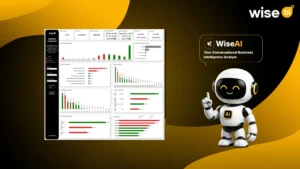
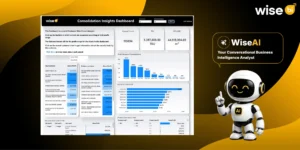
WiseAI supports interactive charts, tables, AI-generated dashboards, and written insights.
These capabilities help CFOs move beyond reviewing individual financial figures to understanding relationships between revenue, costs, profitability, and business activity.
Performance comparisons and AI-generated recommendations can also support discussions about potential financial improvements.
Support Financial Planning and Monitoring
WiseAI’s forecasting and configurable alert capabilities can help finance leaders explore future trends and monitor selected performance conditions.
Conversation history and downloadable reports can support management reviews and follow-up analysis. The availability of individual features depends on the connected data and implementation configuration.
Maintaining Financial Data Security and Governance
Financial information is among the most sensitive data held by a logistics business.
Customer profitability, shipment costs, receivables, and commercial performance should only be accessible to authorized users.
WiseAI is designed around read-only access, role-based control, verifiable answers, and audit-related safeguards.
Read-only access allows users to analyze information without modifying CargoWise business records. Role-based permissions help restrict information according to configured access policies.
Supporting figures and visualizations allow finance teams to review AI-generated findings, while logging controls provide visibility into analytical activity. These safeguards depend on the organization’s deployed security and data-access configuration.
Turning Financial Insights Into Better CFO Decisions
Financial visibility creates value when it influences business decisions.
A CFO who identifies declining margins can work with operations and commercial teams to investigate the causes. When receivables increase, finance teams can review customer exposure and prioritize collection activities.
AI-powered BI makes these investigations easier by reducing the effort required to find, compare, and interpret relevant information.
However, effective financial management still depends on accurate source data, consistent reporting definitions, and collaboration between finance and operational teams.
When these elements work together, CFOs can use business intelligence as an ongoing decision-support capability rather than relying entirely on periodic financial reports.
Conclusion
For logistics CFOs, financial visibility means understanding where revenue comes from, which activities generate profit, how customer payments affect cash flow, and where financial performance requires attention.
AI-powered BI helps connect these areas through accessible reporting, performance comparisons, and analytical insights.
With WiseBI’s CargoWise dashboards and WiseAI, finance leaders can investigate financial performance more efficiently and use data-backed insights to support profitability, working capital management, and business planning.
Want better financial visibility across your CargoWise operations? Schedule a free demo to explore how WiseBI can support your logistics finance team.