

The next generation of freight forwarding leaders won’t be judged only by how much cargo their companies move. They’ll also be judged by how well they understand the business behind every shipment.
Which customers contribute the most profit? Where are margins declining? Which trade lanes are growing, and which branches need attention?
These questions influence business growth, yet finding reliable answers can still involve hours of reporting and analysis. As freight forwarding becomes more competitive, leadership decisions need more than operational experience and periodic financial reports.
Data-driven leadership brings operational knowledge, business intelligence, and AI-powered insights together to help freight forwarders understand performance, anticipate changes, and make informed decisions.
The Changing Role of Leadership in Freight Forwarding
Freight forwarding leadership has traditionally focused on customer relationships, carrier negotiations, operational efficiency, and international shipments. These responsibilities remain essential, but managing a growing logistics business requires greater data visibility.
Companies operating across multiple countries, branches, transport modes, and customer segments generate operational and financial information that influences overall performance.
For example, shipment volumes may increase while profitability declines because of rising carrier costs. A major customer may continue generating revenue while gradually reducing shipment frequency.
Leaders need visibility into these relationships to understand how operational activity affects financial results and identify where action is needed.
What does Data-Driven Leadership Mean for Freight Forwarders?
Data-driven leadership means using accurate, relevant business information to support strategic and operational decisions.
For freight forwarders, this involves connecting shipment activity, customer performance, profitability, and financial information rather than reviewing each area separately.
A CEO needs to understand overall business performance. A CFO focuses on profitability and receivables, while operations leaders monitor shipment volumes and branch productivity.
Although their responsibilities differ, their decisions are connected. An increase in shipment volume may require additional resources, but if those shipments generate lower margins, management must consider whether the growth is financially sustainable.
Data-driven leadership helps teams examine these relationships and make decisions based on a shared understanding of business performance.
How is Business Intelligence Changing Freight Forwarding Leadership?
Business intelligence helps logistics companies monitor operations and evaluate business results through connected dashboards rather than relying entirely on month-end reports.
Greater Visibility Into Business Performance
Company-wide revenue provides only a partial view of performance. Leaders also need visibility into gross profit, shipment activity, customer contributions, and business unit results.
BI dashboards bring these measurements into structured reporting views, making it easier to identify differences between branches, departments, and transport modes.
Faster Access to Relevant Information
Traditional reporting may involve exporting CargoWise data, preparing spreadsheets, and combining multiple reports.
BI dashboards reduce repeated reporting work by providing access to established KPIs and historical trends. This allows leaders to spend more time interpreting results and discussing actions.
More Consistent Decisions Across Departments
Different departments may interpret business performance differently. Sales teams often focus on revenue, while finance teams evaluate gross profit and receivables.
A shared BI environment helps establish consistent KPI definitions and improves coordination between leadership, finance, sales, and operations.
The Role of AI in the Future of Data-Driven Leadership
Business intelligence provides performance visibility, while AI-powered analytics makes information easier to explore and interpret.
Conversational Business Intelligence
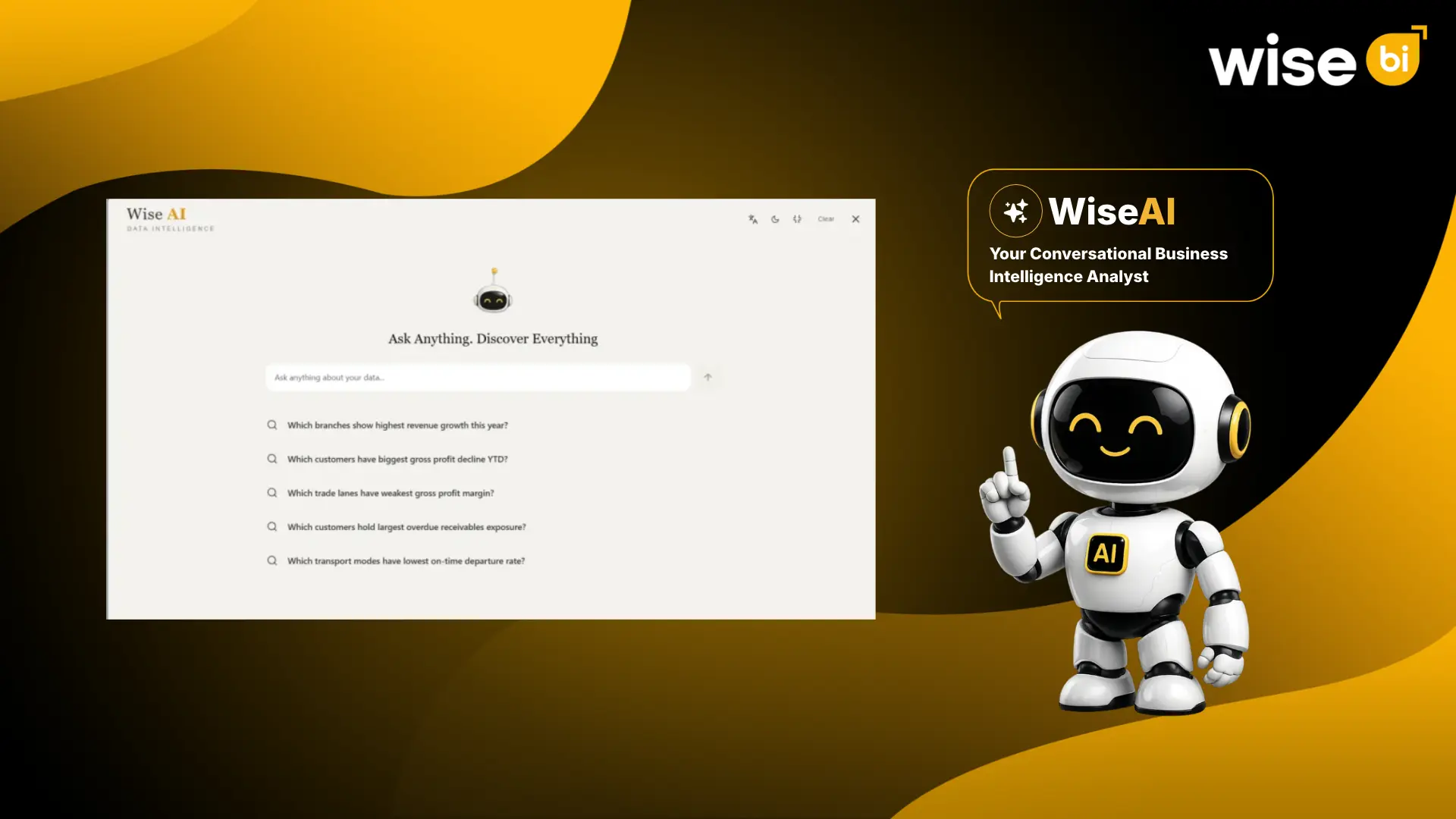
Natural language querying allows leaders to ask questions using everyday language.
For example, a CEO could ask, “Which branches generated the highest gross profit growth this quarter?”
An AI-powered BI system can present relevant results from connected business data. Follow-up questions allow leaders to investigate customers, departments, or reporting periods without technical reporting expertise.
AI-Generated Insights and Recommendations
AI-powered analytics helps identify business patterns and provides written explanations of results.
For example, declining customer revenue may prompt further investigation into shipment frequency or account activity.
AI-generated recommendations help leaders evaluate potential actions using their commercial knowledge and operational experience.
Forecasting and Forward-Looking Analysis
Historical reporting explains previous performance, while forecasting helps management explore potential future trends.
Freight forwarders can use these insights to support shipment demand, revenue, and capacity planning alongside confirmed bookings and market conditions.
Five Priorities for the Future of Freight Forwarding Leadership
1. Profitability Before Shipment Volume
Moving more cargo doesn’t automatically mean stronger profitability. Leaders need to understand how shipment activity contributes to revenue, costs, and gross profit.
Analyzing job profitability, customer margins, and branch performance helps identify sustainable growth opportunities and supports pricing and resource allocation decisions.
2. Customer Retention Through Better Visibility
Customer relationships can change before an account is lost. A customer may reduce shipment volumes, shift trade lanes, or generate lower revenue.
Customer performance analysis helps sales teams identify these changes, prioritize conversations, and investigate declining activity.
3. Financial Visibility Across Operations
Freight forwarding involves complex relationships between shipment costs, customer billing, supplier payments, and receivables.
Connected financial reporting helps CFOs monitor gross profit, outstanding receivables, and customer performance to support cash flow planning and commercial decisions.
4. Operational Planning Based on Business Trends
Operational requirements change with shipment volumes, customer demand, and transport-mode activity.
Analyzing TEUs, air freight tonnage, shipment counts, and job activity helps leaders understand workloads. Combined with forecasting, these insights support staffing and capacity planning.
5. Stronger Accountability Across Business Units
As freight forwarding companies expand, leaders need consistent visibility into branch and departmental performance.
Data-driven management establishes measurable KPIs, supports performance reviews, and helps identify where further investigation or action is required.
How do WiseBI and AI-Powered Data Intelligent Assistants Support Future-Ready Freight Forwarders?
For CargoWise users, WiseBI provides ready-to-use business intelligence dashboards to monitor operational and financial performance across shipments, customers, profitability, branches, countries, and departments.
Our WiseAI extends these capabilities through AI-powered conversational data assistants
Authorized users can ask questions about connected CargoWise data and explore results through charts, tables, and written insights.
WiseAI also supports follow-up questions, AI-generated dashboards, performance comparisons, recommendations, and forecasting to help leaders investigate business performance without creating separate reports.
Depending on the deployment, conversation history, downloadable reports, and configurable alerts can support management reviews and performance monitoring.
Together, WiseBI and WiseAI make business information more accessible to freight forwarding leadership teams.
Why will Data Governance Matter More in AI-Driven Logistics?
As AI becomes more involved in business analysis, freight forwarders must maintain appropriate controls over sensitive operational and financial information.
Our WiseAI is built around read-only access, role-based controls, verifiable answers, and audit safeguards. Read-only access allows analytical queries without changing CargoWise records, while configured permissions help control employee access. Supporting figures and visualizations help users review findings, and logging controls provide oversight of analytical activity.
These safeguards depend on the organization’s deployed security configuration. Reliable data, consistent KPI definitions, and governance remain essential for AI-powered decisions.
Building a Data-Driven Freight Forwarding Organization
The transition toward data-driven leadership doesn’t require replacing every management process. It begins with identifying the decisions that matter most, such as profitability, customer retention, cash flow, and operational performance.
Next, organizations need reliable reporting and consistent, cross-departmental measurements.
BI dashboards support regular monitoring, while AI-powered analysis helps investigate questions arising during management reviews.
Most importantly, insights should lead to meaningful discussions and clearly assigned actions.
When leaders regularly review performance, investigate changes, and evaluate results, data becomes part of everyday decision-making rather than something examined only at month-end.
Conclusion
The future of freight forwarding requires leaders who understand both operational realities and the financial performance behind them.
Experience will continue to guide decisions, while business intelligence and AI-powered analytics provide clearer evidence, deeper insights, and visibility into emerging challenges.
With WiseBI’s CargoWise dashboards and WiseAI, freight forwarders can bring operational and financial data closer to everyday leadership decisions.
Ready to build a more data-driven freight forwarding business?
Schedule a free demo to explore how WiseBI and AI-Powered data intelligent assistants can support your leadership team.