

The freight forwarding industry is moving toward a future where business success depends on more than moving cargo efficiently.
Customer expectations are changing, operating costs remain a concern, and logistics companies are managing increasing amounts of business data. Yet having access to more information doesn’t automatically lead to better decisions.
A freight forwarder may have complete shipment records but still struggle to understand why profitability is declining, why customers are reducing their business, or where operational resources are being underutilized.
This is where artificial intelligence (AI), business intelligence (BI), and strategic leadership come together. By connecting operational and financial information, freight forwarders can gain clearer visibility into performance, identify opportunities, and make more informed business decisions.
Why is Freight Forwarding Entering a New Era?
Freight forwarding involves coordinating shipments, carriers, customers, customs processes, warehouses, and transport providers. Alongside these operations, businesses must manage profitability, customer relationships, and financial performance.
As companies expand across countries, branches, and transport modes, understanding these connections becomes more challenging.
For example, higher shipment volumes may increase revenue while rising carrier costs reduce profit margins. Similarly, a high-revenue customer may contribute less profit because of additional service requirements.
Traditional reports often show these results separately, making it difficult to understand the complete business picture. The next era of freight forwarding requires companies to connect operational activity with financial outcomes and use those insights to guide decisions.
The Role of Business Intelligence in Modern Freight Forwarding
Business intelligence helps freight forwarders transform operational and financial information into structured dashboards, reports, and performance insights. Instead of reviewing disconnected figures, management teams can understand how different business activities contribute to overall results.
Understanding Shipment and Operational Performance
Shipment data provides information about freight volumes, transport modes, trade lanes, and branch activity. WiseBI’s shipment and volume analysis dashboards help operations leaders compare shipment trends, identify changes in cargo volumes, and understand workload distribution.
For example, comparing ocean freight TEUs across reporting periods can help management recognize changes in shipment activity and plan operational resources accordingly.
Improving Profitability Visibility
Revenue growth is important, but profitability determines whether that growth is financially sustainable.
BI dashboards help freight forwarders examine job profitability, customer margins, and financial performance across branches and departments. A branch handling more shipments may generate lower gross profit than another branch with fewer, higher-margin jobs.
Understanding these differences supports pricing reviews, cost management, and commercial planning.
Connecting Financial and Operational Data
Freight forwarding involves financial transactions linked to shipments, customers, carriers, and service providers. Business intelligence helps management examine these relationships rather than reviewing financial and operational results separately.
For example, finance teams can compare customer revenue with shipment activity or investigate changes in gross profit alongside operational volumes. This provides a clearer understanding of how daily freight operations influence financial performance.
How is AI Changing Logistics Business Intelligence?
Traditional BI dashboards provide consistent views of established KPIs. AI-powered analytics makes business information easier to explore, compare, and interpret.
Asking Business Questions in Everyday Language
Natural language querying allows leaders to ask questions without writing SQL queries or manually configuring reports.
A freight forwarding CEO might ask, “Which customers contributed the most gross profit last quarter?”
An AI-powered BI system can interpret the question and present relevant results from connected business data. Follow-up questions allow management to investigate specific customers, branches, or reporting periods without preparing another report.
Understanding Trends through AI-Generated Insights
AI-powered analytics can identify patterns in operational and financial information and explain results through written summaries.
For example, when customer revenue declines, management can investigate changes in shipment frequency, trade lane activity, or service mix. AI-generated recommendations help leaders evaluate potential actions based on available findings.
Supporting Forecasting and Business Planning
Historical reporting explains previous performance, while forecasting helps businesses explore potential future trends.
AI-assisted forecasting can support discussions about shipment demand, revenue expectations, and operational capacity. Freight forwarders can combine these insights with confirmed bookings, customer commitments, and market conditions when planning resources.
Strategic Leadership in the Next Era of Freight Forwarding
Technology provides information, but leadership determines how that information influences business decisions. Strategic leaders need to connect data analysis with clear commercial and operational priorities rather than focusing only on technology adoption.
Prioritizing Profitable Business Growth
Increasing shipment volumes doesn’t automatically improve profitability. Leaders need to evaluate customer margins, job profitability, and branch performance before making growth decisions.
Power BI and AI-powered analytics help identify which business areas contribute positively to financial results and where further investigation is needed. These insights support pricing reviews, supplier negotiations, and resource allocation.
Strengthening Customer Relationships
Customer retention remains essential in freight forwarding, particularly for businesses relying on long-term commercial relationships.
Changes in shipment frequency, revenue, or trade lane activity may indicate that an account requires attention. Customer analytics helps sales leaders identify these patterns and prioritize follow-up conversations before relationships deteriorate.
Improving Financial Control
Freight forwarders often manage differences between supplier payment obligations and customer payment timelines. Outstanding receivables, rising service costs, and declining margins can affect working capital.
Our financial operational dashboards help CFOs monitor customer balances, profitability, and financial trends to support collection priorities, credit reviews, and cash flow management.
Building Accountability Across Branches
Businesses operating across multiple locations need consistent performance measurements.
Strategic leadership involves establishing relevant KPIs, reviewing results regularly, and understanding differences between business units. BI dashboards provide structured performance information, while AI-powered analysis helps leaders investigate unexpected changes and improve accountability.
How does WiseBI Support the Next Era of Freight Forwarding?
For businesses using CargoWise, we provide an integrated, AI-powered business intelligence solution with ready-to-use dashboards and custom BI development, helping improve visibility into logistics operations and financial performance so teams can make informed, data-driven decisions.
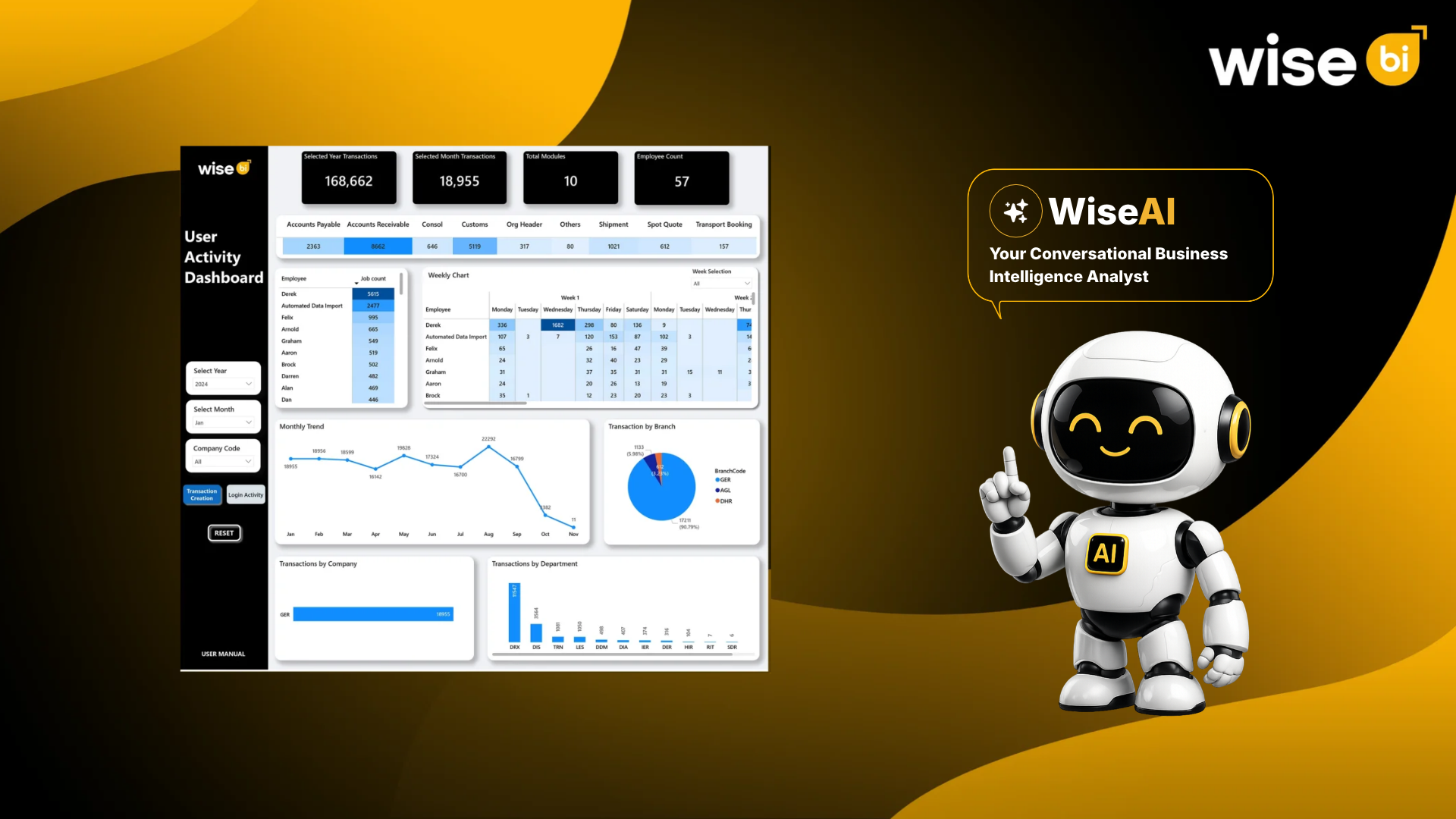
These dashboards help management review shipments, customers, profitability, branches, countries, and departments through structured reporting views.
Our WiseAI extends these capabilities through AI-powered conversational business intelligence. Authorized users can ask questions about connected CargoWise reporting data and explore results through charts, tables, written insights, and AI-generated dashboards.
WiseAI also supports follow-up questions, performance comparisons, recommendations, and forecasting capabilities. Conversation history, downloadable reports, and configurable alerts can further support management reviews and performance monitoring, depending on the deployment.
Together, WiseBI and WiseAI help freight forwarding leaders investigate business performance and make informed decisions without depending entirely on manual reporting.
Why does Data Governance Matter for AI Adoption?
As AI becomes more involved in business analysis, protecting operational and financial information remains essential. Freight forwarders manage sensitive data covering customer revenue, shipment costs, profitability, and commercial relationships.
WiseAI is built around read-only access, role-based controls, verifiable answers, and audit safeguards.
Read-only access allows analytical queries without modifying CargoWise business records, while configured permissions help control which information authorized employees can access.
Supporting figures and visualizations help users review AI-generated findings, while logging controls provide oversight of analytical activity. These safeguards depend on the organization’s deployed security configuration.
Reliable data and consistent KPI definitions remain equally important for trustworthy analysis.
Preparing Your Freight Forwarding Business for the Future
Adopting AI and BI doesn’t require replacing existing operational expertise or management processes. A practical starting point is identifying the decisions that matter most, such as improving profitability, managing receivables, retaining customers, or planning operational capacity.
Organizations should then establish reliable reporting and consistent KPIs across departments.
BI dashboards support regular performance monitoring, while AI-powered business intelligence analytics helps investigate questions arising during management discussions. Most importantly, analytical findings should lead to clear business actions.
When leaders regularly review performance, investigate changes, and evaluate outcomes, data becomes part of everyday management rather than something reviewed only at month-end.
Conclusion
Bring AI, BI, and Leadership together.
The next era of freight forwarding will require businesses to understand not only how cargo moves but also how operational decisions affect profitability, customer relationships, and financial performance.
Business intelligence provides visibility, AI makes analysis more accessible, and strategic leadership turns those insights into meaningful decisions.
With WiseBI’s CargoWise dashboards and WiseAI, freight forwarders can bring these capabilities together to support more informed business management.
Ready to prepare your freight forwarding business for the next era? Schedule a free demo to explore how WiseBI and WiseAI can support your business.