



A container arrives at the destination port, but the consignee hasn’t completed customs clearance. Free time continues to run, storage charges begin accumulating, and the empty container return deadline is approaching.
By the time the freight forwarder identifies the delay, additional charges may already be unavoidable.
For freight forwarding companies handling hundreds of containers, these costs can affect shipment profitability, customer relationships, and working capital.
The challenge isn’t always the carrier’s rates. Delayed documents, customs holds, missed collection appointments, and late empty returns can all contribute to avoidable charges.
This is where detention and demurrage analytics become valuable. By measuring container milestones, free-time usage, charges, and customer recoveries, freight forwarders can identify recurring delays and make better decisions using their operational data.
Understanding Free Time, Detention, Demurrage, and Storage Charges
Before analyzing container-related costs, freight forwarders need to distinguish between four important terms.
Free Time
Free time is the agreed period during which a container or cargo can remain at a terminal or outside the terminal without incurring specified additional charges. The allowance depends on carrier terms, terminal rules, service contracts, and the shipment’s location.
Demurrage
Demurrage generally refers to charges associated with a container remaining within the terminal beyond the applicable free-time allowance. These charges can increase as the delay continues, depending on the carrier’s tariff or contractual terms.
Detention
Detention typically applies when a shipping line’s container remains outside the terminal beyond the permitted free period. For imports, this often happens when a consignee delays unloading or returning the empty container.
Storage
Terminal storage charges apply when cargo or containers occupy terminal space beyond the relevant storage allowance. Storage and demurrage may be charged separately, depending on the terminal, carrier, and applicable agreement.
Understanding these differences matters because each charge may have a different trigger, responsible party, free-time period, and recovery process.
Why do Detention and Demurrage Costs Keep Increasing?
A freight forwarder may know how much was charged on a shipment without knowing which process caused the delay.
Consider an import container that becomes available at the terminal on Monday.
Customs documentation isn’t completed until Wednesday. The customer schedules collection for Friday, but the available free time expires on Thursday.
The container incurs additional charges before collection.
A shipment report may record the charges, but management needs to understand whether the delay resulted from documentation, customs clearance, transport scheduling, or customer readiness.
Without consistent event and cost data, these problems can repeat across customers, ports, and trade lanes.
Detention and demurrage analytics help freight forwarders investigate patterns rather than treating every charge as an isolated exception.
Which Detention and Demurrage KPIs Should Freight Forwarders Track?
The most useful analytics connect container events with financial outcomes.
| KPI | What it Reveals |
| Charges per container | Average detention, demurrage, and storage costs incurred |
| Free time used | How much of the available allowance was consumed? |
| Containers exceeding free time | Frequency of containers passing applicable deadlines |
| Charges by port or terminal | Locations contributing to additional costs |
| Charges by customer | Accounts associated with recurring delays |
| Customer recovery rate | Percentage of eligible charges successfully recovered |
For example, if one destination port consistently generates higher demurrage costs per container, management can investigate terminal congestion, documentation delays, and local transport arrangements.
Similarly, a low customer recovery rate may indicate unclear contractual terms, delayed invoicing, or disputed charges.
These measures help freight forwarders understand both the operational cause and financial impact of container delays.
How can Data Identify the Root Causes of Container Delays?
Knowing that a container incurred demurrage is only the beginning. Preventing future charges requires identifying why the delay occurred.
Late Shipping or Customs Documents
Missing commercial invoices, incorrect shipment details, or delayed clearance documents can prevent timely cargo release.
By comparing document completion dates with container availability and free-time deadlines, forwarders can identify recurring documentation bottlenecks.
Customs Holds and Inspection Delays
Customs inspections or regulatory holds may prevent collection even when the freight forwarder has completed the required documentation.
Tracking hold dates, release dates, and associated charges helps teams distinguish customs-related delays from other operational issues.
Customer Collection Delays
A consignee may not have sufficient warehouse capacity, unloading resources, or transport arrangements to receive the container.
Analyzing customer collection dates and free-time utilization can reveal accounts that repeatedly collect containers close to or after the deadline.
Late Empty Container Returns
Even after delivery, detention may continue accumulating until the empty container is returned according to the applicable terms.
Tracking delivery, unloading, and empty return events helps identify delays involving customers, transport providers, or equipment return arrangements.
What Data does CargoWise Hold, and What Else is Needed?
CargoWise can hold valuable shipment, container, customer, operational milestone, billing, and financial information, depending on how the business uses and configures the system.
This provides a foundation for detention and demurrage analysis.
However, accurate free-time monitoring may require information that isn’t consistently available within CargoWise.
Additional data may include:
- Carrier-specific free-time allowances and applicable tariff rules.
- Container discharge, availability, gate-out, and empty return events.
- Terminal storage deadlines and charge schedules.
- Customs hold and release information.
- Customer collection appointments and transport milestones.
These records may come from shipping lines, terminals, port community systems, transport providers, or other approved data sources.
Combining them with CargoWise shipment and financial records helps establish a clearer picture of container movement, charge exposure, and recovery.
Without reliable milestone dates and contractual terms, BI dashboards cannot accurately calculate every deadline or potential charge.
How can WiseBI Help CargoWise Users Analyze these Costs?
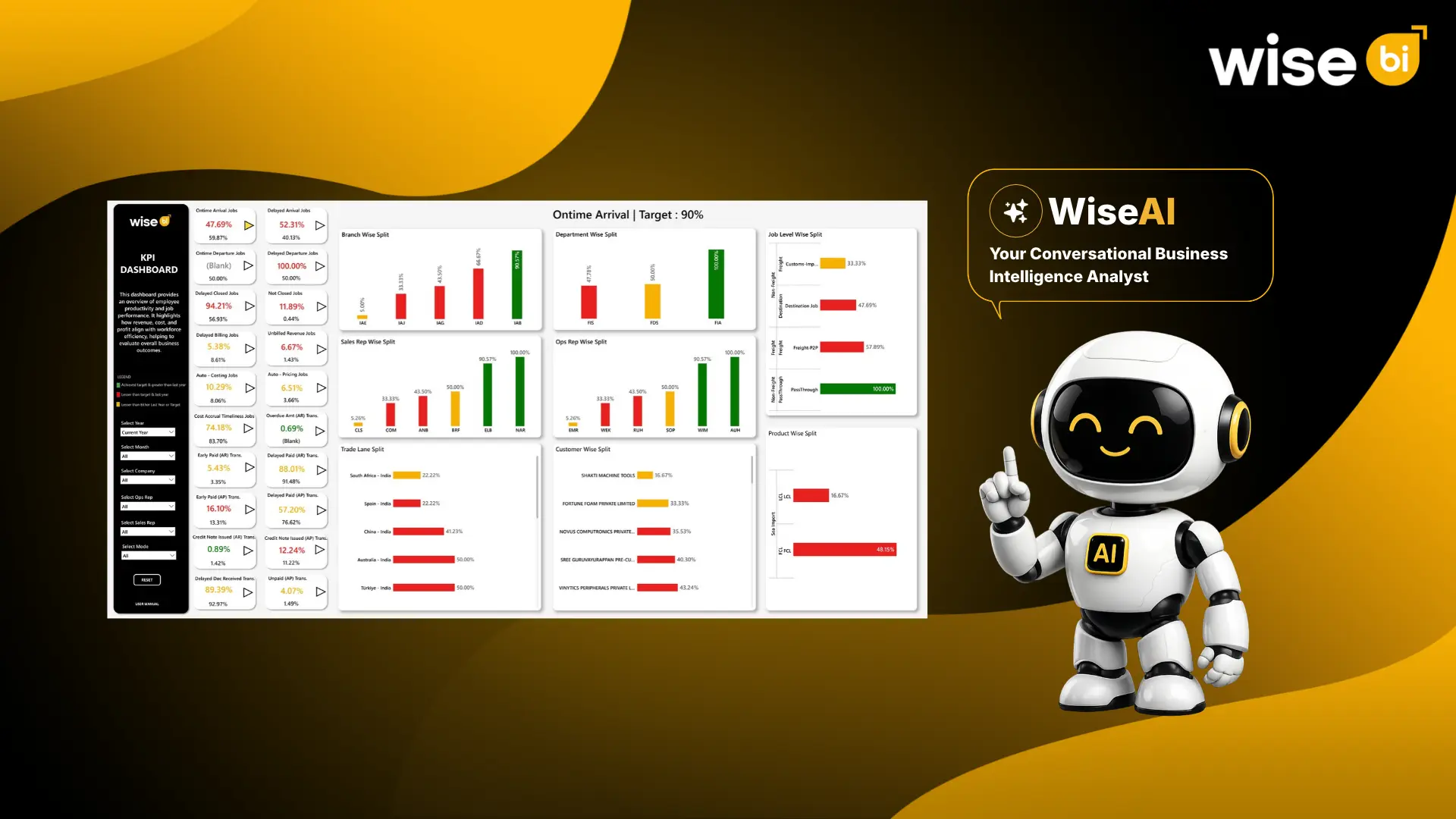
We provide AI-powered CargoWise business intelligence dashboards and custom BI development services that can support detention and demurrage analysis.
Monitor Container Performance Through Control Tower Dashboards
A configured control tower dashboard can bring together container milestones, free-time allowances, and upcoming deadlines.
When teams integrate timely event data and alerting capabilities, they can identify containers approaching free-time expiry and prioritize follow-up actions.
For example, operations could review containers awaiting customs release, collection, or empty return before additional charges arise.
This requires suitable carrier or terminal data feeds and configured alert rules; it isn’t an automatic capability of every standard dashboard.
Identify Revenue Leakage and Unrecovered Charges
Detention and demurrage charges can reduce shipment profitability when additional costs are not fully recovered from customers.
WiseBI’s revenue and cost dashboards help logistics companies compare shipment revenue, direct costs, and gross profit to identify potential margin leakage.
For example, managers can investigate shipments with increased detention and demurrage expenses, review customer billing, and identify unrecovered charges where the relevant cost and recovery data is available.
This helps freight forwarders improve cost visibility, strengthen billing accuracy, and protect shipment profitability.
Connect Terminal and Carrier Data Through Custom BI
Not every freight forwarder receives container events and free-time information in the same format.
Our custom BI development services can help businesses design reporting models that combine CargoWise information with approved external data feeds.
Depending on integration availability, these models can support container-level tracking, free-time utilization analysis, cost comparisons, and management reporting.
WiseAI can also support natural-language exploration of validated reporting data, allowing authorized users to investigate trends and charge patterns through business questions.
Conclusion
Detention, demurrage, and storage charges aren’t always avoidable. However, better visibility into container events, free-time deadlines, and cost recovery can help freight forwarders identify preventable delays.
The key is linking operational milestones to financial data.
By analyzing charges per container, free-time usage, recurring delay causes, and customer recovery rates, freight forwarders can identify where process improvements may reduce unnecessary costs.
WiseBI helps CargoWise users build clearer operational and financial reporting through logistics-focused dashboards, custom BI development, and WiseAI conversational analytics.
Want better visibility into container delays and their financial impact?
Book a free demo with WiseBI to discuss how custom CargoWise BI dashboards and integrated container data can support your detention and demurrage cost analysis.


