


For a freight forwarder, completing a shipment and issuing an invoice are only part of the financial cycle. The job truly turns into cash when the customer pays.
As a forwarding business grows, keeping track of that process becomes more challenging. More customers bring more invoices, different payment terms, varying credit limits, and outstanding balances across multiple accounts. CargoWise may contain the underlying financial data, but finance teams still need a clear way to understand what those numbers mean for collections and customer exposure.
How much is outstanding? Which payments are overdue? Which customers are taking longer to pay? Are any accounts exceeding their credit limits? And, more importantly, where should the collections team focus first?
The CargoWise accounts receivable dashboard brings these answers together. Instead of viewing receivables as a single number, teams can analyze overdue payments, debtor days, customer balances, credit exposure, WIP, and the individual transactions behind them.
The result is not simply better reporting. It is a clearer way to understand where cash is tied up and which accounts require attention.
Why does Accounts Receivable Visibility Matter for Freight Forwarders?
Accounts receivable represents money the business has earned but has not yet collected. When payments take longer to arrive, more working capital remains tied up in outstanding customer balances.
For freight forwarders managing large numbers of customers and transactions, the total AR balance tells only part of the story.
Finance teams also need visibility into:
- Total receivables
- Overdue receivables
- Overdue percentage
- Average debtor days
- Customer outstanding balances
- Credit-limit exposure
- Work in progress
- Transaction-level details
Looking at these measures together gives teams context. A large customer balance, for instance, may still be within agreed payment terms, while a smaller balance may have been overdue for weeks.
That difference can influence which account should be followed up first.
What should a Better CargoWise Accounts Receivable Dashboard Show?
An effective accounts receivable dashboard for freight forwarders should make the overall financial position easy to understand while allowing users to investigate the details behind it.
Total Receivables and Overdue Payments
The starting point is a clear view of how much is outstanding and how much has already passed its due date.
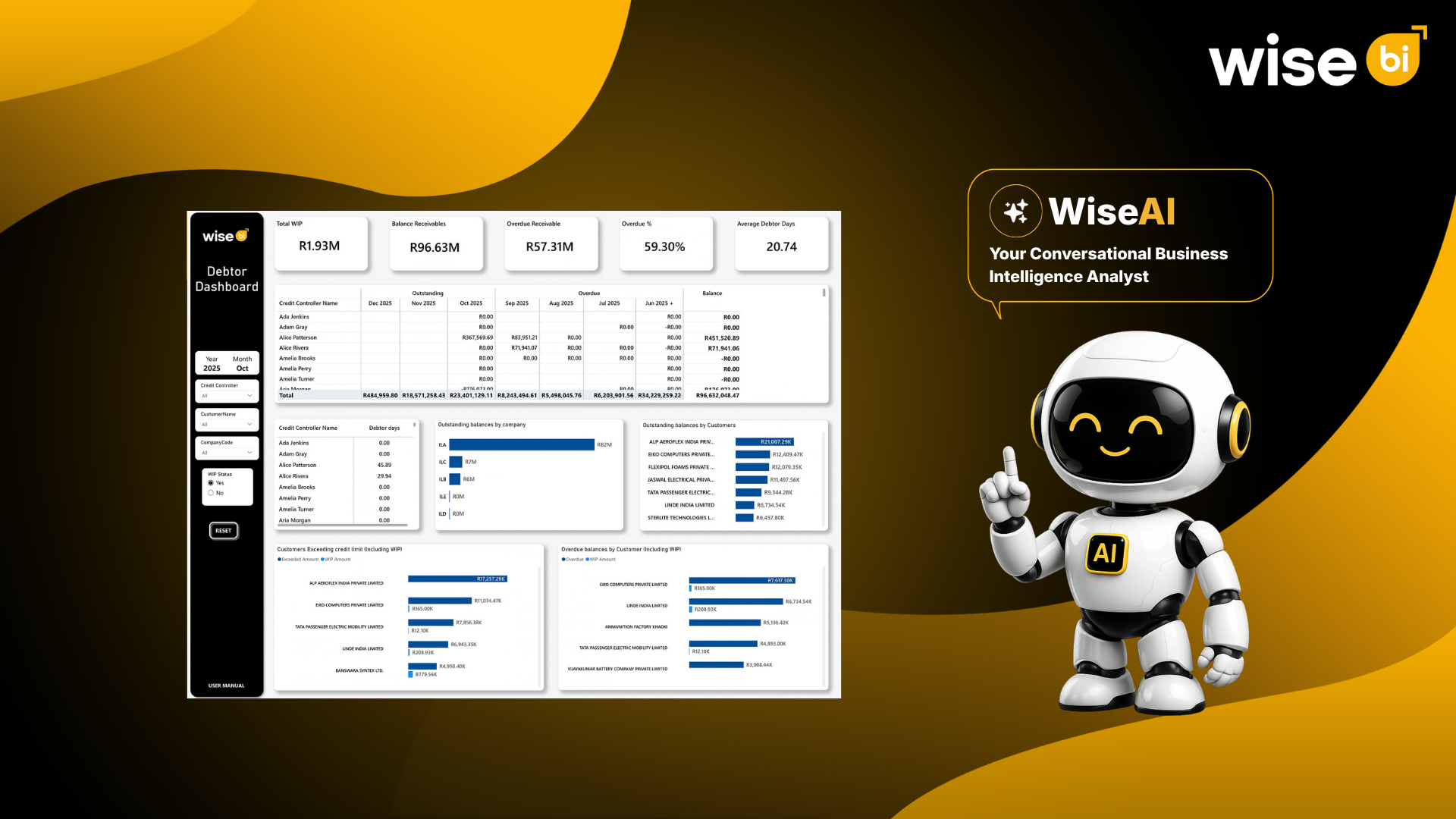
The WiseBI’s Debtor Dashboard brings together balance receivables, overdue receivables, overdue percentage, average debtor days, and total WIP in its high-level view.
These metrics help finance teams quickly understand the scale of outstanding receivables and the portion that may require collection attention. If overdue receivables increase, teams should be able to identify which customers and transactions are responsible.
Average Debtor Days
Debtor days provide another perspective on collection performance by helping teams understand how long customers are taking to settle outstanding amounts.
A change in debtor days can signal a change in payment behavior even before the total receivables balance becomes an obvious concern.
The dashboard can also analyze debtor days by credit controller, giving management visibility into collection performance across responsible teams.
Debtor days become particularly useful when reviewed alongside overdue balances and aging rather than as a standalone KPI.
Outstanding Balances by Customer
Knowing the total amount owed is useful. Knowing who owes it makes the information actionable.
Customer-level analysis helps identify where outstanding receivables are concentrated. The dashboard provides outstanding balances by company and customer, allowing finance teams to see which accounts contribute most heavily to the overall position.
This helps collections teams move away from treating every account equally and toward reviewing customers based on actual exposure.
Tracking Customers with High Credit Exposure
Overdue invoices are not the only financial risk finance teams need to watch.
A customer’s invoices may still be within their payment terms while the overall account has already exceeded its approved credit limit.
That makes credit exposure an important part of CargoWise receivables analysis.
The BI dashboard identifies customers exceeding their credit limits and provides visibility into exceeded amounts and WIP amounts.
Finance and commercial teams can use this information as additional context when reviewing customer accounts and deciding whether closer attention is needed.
Connecting Credit Limits With WIP
For freight forwarders, customer exposure may extend beyond invoices that have already been raised.
A customer could have outstanding receivables while additional jobs remain in progress. Looking at WIP alongside credit limits therefore provides a broader picture of the financial relationship.
This does not mean WIP and receivables should be treated as the same thing. Rather, viewing them together provides useful context when assessing overall customer exposure.
From AR Summary to Transaction-Level Detail
The CargoWise Power BI dashboard should not stop at identifying a problem. It should help users investigate it.
Suppose a customer appears among the largest overdue accounts. Finance now needs to understand what is driving that balance.
Which transactions are involved? When were they posted? When were they due? How much has been paid? How much remains outstanding?
This is where drill-through analysis becomes valuable.
Invoice, Payment, and Aging Details
The transaction-level view can provide information including customer, credit controller, company code, transaction number, transaction type and status, post date, due date, invoice amount, paid amount, pending amount, overdue amount, and aging days.
This creates a natural analytical path:
Overall AR → Customer → Overdue balance → Individual transaction
Instead of jumping between separate reports to understand a balance, users can move from the high-level issue toward the underlying detail.
Using WIP Alongside Accounts Receivable
Work in progress deserves its own visibility in freight forwarding finance.
The WiseBI’s accounts receivable dashboard includes WIP drill-through information such as customer, company code, job number, period, and WIP amount.
This allows teams to distinguish between amounts already billed and outstanding amounts associated with jobs still in progress.
For management, combining these perspectives provides more context when reviewing customers with significant financial exposure.
How can Finance Teams Prioritize Collections?
A long list of outstanding invoices does not automatically tell a collections team where to begin.
A better approach is to review several indicators together:
Outstanding balance: How much does the customer currently owe?
Overdue amount: How much has passed its due date?
Aging days: How long has the amount remained outstanding?
Debtor days: How quickly is the customer generally paying?
Credit exposure: Is the account exceeding its approved credit limit?
WIP: Is there additional work in progress associated with the customer?
Taken together, these measures create a much stronger basis for prioritizing collections than overdue value alone.
A large balance may not always be the first account that needs attention. Payment behavior, aging, and credit exposure provide the context needed to make that decision.
Common Accounts Receivable Reporting Mistakes
Looking Only at the Total AR Balance
A total receivables number does not reveal which customers, companies, or transactions are driving the balance.
Treating Every Overdue Account the Same
A newly overdue invoice and one that has remained unpaid for a much longer period should not automatically receive the same collection priority.
Ignoring Changes in Debtor Days
Looking only at balances can make gradual changes in customer payment behavior harder to notice.
Reviewing Credit Exposure Too Late
Waiting until invoices become significantly overdue can mean missing earlier signs of increasing customer exposure.
Depending Too Heavily on Manual Spreadsheets
CargoWise report exports, reconciliations, and spreadsheet updates can make receivables analysis time-consuming and leave teams working from different versions of the information.
Stopping at Summary-Level Reporting
Management needs the overview, but finance teams also need access to customer and transaction details when something requires investigation.
Turning CargoWise AR Data Into Better Collection Decisions
A better AR dashboard is not valuable simply because it displays more financial information. Its value comes from connecting information in a way that supports action.
For freight forwarders using CargoWise, that means moving logically from:
Receivables position → Overdue exposure → Customer → Credit position → Aging → Transaction detail
Finance teams can see the overall picture, identify the accounts that deserve attention, and then investigate the underlying transactions without losing context.
That makes accounts receivable reporting more useful for day-to-day collections and broader financial management.
Conclusion
For freight forwarders, effective accounts receivable management requires more than knowing the total amount customers owe.
Finance teams need to understand which payments are overdue, how long customers take to pay, where credit exposure is increasing, and which transactions contribute to outstanding balances.
A well-designed CargoWise accounts receivable dashboard connects these insights in one place. It helps finance teams, credit controllers, business owners, and management spend less time finding the story behind the numbers and more time deciding what needs attention.
Want clearer visibility into your CargoWise receivables? Book a free demo with WiseBI to see how your finance, credit, operations, and management teams can monitor overdue payments, debtor days, customer exposure, WIP, and transaction details through a connected accounts receivable dashboard.