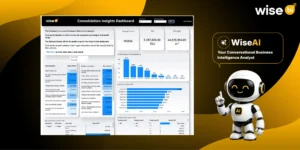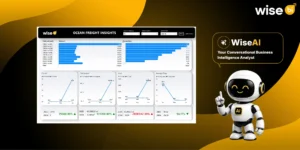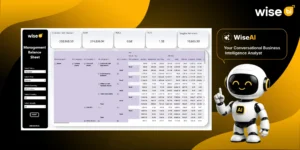



Logistics companies already have data on shipment activity, expenses, margins, warehouse performance, customer KPIs, and exceptions. But here’s the important question: does seeing the data automatically tell your team what to do next?
That’s where logistics Business Intelligence is changing. The next generation of BI is moving beyond simply displaying performance toward helping teams identify problems, understand their impact, predict what could happen next, and prioritize the right response.
Data Visibility is No Longer Enough
Logistics companies have invested heavily in real-time data visibility, but it is only the beginning. According to a recent 2026 survey, 97% of decision-makers believe that visibility alone is no longer sufficient. The challenge is to turn that visibility into actionable information.
A modern logistics dashboard needs to help teams understand:
- What changed across operations or financial performance
- Where the problem occurred across shipments, customers, branches, or trade lanes
- Why it matters to service, cost, margin, or customer commitments
- What requires attention first, instead of treating every exception equally
This is where dashboards begin moving closer to decision intelligence.
More Data Doesn’t Always Mean Faster Decisions
Freight forwarders, NVOCCs, 3PLs, and logistics providers generate information across transportation systems, warehouse platforms, ERP applications, carrier portals, finance systems, and customer platforms. In fact, recent research found that 66% of surveyed logistics teams use three or more systems to manage shipments.
When information is fragmented, teams may still spend valuable time comparing reports before making a decision.
The difficulty often comes from:
- Data is being spread across multiple systems
- Different departments work with different KPIs
- Too many alerts competing for attention
- Operational and financial information is being analyzed separately
- Managers manually investigate what caused a KPI to change
So, the problem isn’t necessarily a shortage of data. Sometimes, it’s too much information without enough context.
From Reporting What Happened to Deciding What Comes Next
Traditional reporting is largely historical. BI dashboards make reporting more interactive and real-time. Predictive analytics is now pushing BI further by helping businesses understand where performance could be heading.
The evolution can be understood simply:
- Reporting: What happened?
- Dashboard: What is happening?
- Predictive BI: What could happen next?
- Decision intelligence: What should we do about it?
- Agentic AI: Can an approved action be carried out automatically?
That last stage is getting significant attention in 2026. Gartner identifies agentic AI as one of the major technologies shaping supply-chain transformation, although truly autonomous decision-making remains an emerging capability rather than the norm today.
Not Every Logistics Exception has the Same Impact
Imagine your BI dashboard shows ten delayed shipments.
Should operations treat all ten as equally urgent?
Probably not.
A more intelligent dashboard could help teams prioritize exceptions based on additional business context, such as
- Customer importance and service commitments
- Shipment value or cargo priority
- Potential demurrage, detention, or storage exposure
- Job profitability and additional operational costs
- Downstream delivery consequences
- Historical carrier or trade-lane performance
Instead of simply asking, “Which shipments are delayed?” teams can ask, “Which delay requires our attention first?”
That’s a much more valuable BI question.
Predictive Dashboards can Create More Time to Act
The value of predictive BI isn’t that it can perfectly forecast every logistics disruption. It’s that it can identify patterns early enough to give teams more time to investigate.
Recent research found that only 59% of surveyed organizations proactively use logistics data to predict and prevent issues, showing there is still a significant gap between collecting data and using it proactively.
Predictive dashboards could help identify:
- Increasing dwell times
- Recurring carrier delays
- Unusual freight-cost movements
- Declining customer or trade-lane margins
- Growing warehouse congestion
- Changes in shipment volumes
- Repeated operational exceptions
The earlier a pattern is identified, the more opportunity a logistics team may have to respond before it becomes a larger problem.
AI Is Bringing Dashboards Closer to Decisions
AI is also changing how users interact with business intelligence. Instead of manually navigating every chart, filter, and report, AI-powered BI can help users explore data, summarize changes, detect unusual patterns, and ask business questions using natural language.
The next step is more interesting.
A future decision engine could potentially:
- Detect an unusual KPI movement
- Investigate contributing data
- Identify the likely business impact
- Recommend possible responses
- Prioritize the recommended action
- Trigger approved workflows within defined controls
This doesn’t remove human decision-making. It can give experienced logistics professionals better information before they make the decision.
Better Decisions Still Depend on Better Data
There’s one important catch.
Smarter dashboards don’t automatically fix poor underlying data.
If customer records are inconsistent, operational milestones are incomplete, costs aren’t captured correctly, or systems remain disconnected, AI can produce conclusions based on an unreliable foundation.
Before moving toward more autonomous BI, logistics businesses need:
- Consistent and trusted operational data
- Connected operational and financial systems
- Clearly defined KPIs
- Reliable master data
- Appropriate AI governance and permissions
- Human oversight for important decisions
The more responsibility businesses give AI, the more important these foundations become.
The Dashboard Isn’t Disappearing. It’s Evolving.
Dashboards will continue to be important because people still need a clear way to understand business performance.
What’s changing is what happens after a KPI appears on the screen.
The next generation of logistics BI can increasingly help teams move through a connected sequence:
See the change → understand the cause → predict the impact → prioritize the response → take action.
That is the real shift from a dashboard toward a decision engine.
Final Thoughts
Logistics companies don’t necessarily need more dashboards. They need dashboards that help people understand what matters and what deserves action.
As predictive analytics, decision intelligence, and agentic AI continue developing, Business Intelligence is moving closer to the decisions that shape freight operations, customer service, costs, and profitability.
With the right logistics BI solution, freight forwarders connect operational and financial data through intelligent dashboards, predictive insights, and decision-ready analytics, helping logistics teams move from simply seeing what happened to understanding what they should do next.