


For an NVOCC, almost every freight movement creates data.
Bookings, shipments, containers, customers, carriers, milestones, invoices, costs, revenue, and operational exceptions all contribute to the information generated through daily CargoWise operations.
So, here’s the bigger question:
How much of your CargoWise data is actually helping you make better business decisions?
Having data and understanding it are two different things.
CargoWise provides the operational foundation, but as shipment volumes and transactions grow, management teams may need a clearer way to analyze performance across customers, trade lanes, branches, operations, and finance.
That’s where CargoWise Business Intelligence dashboards become valuable.
📊 CargoWise Data Goes Far Beyond Shipment Reporting
When people think about freight data, shipment status is often the first thing that comes to mind.
But CargoWise data can support a much wider business picture.
For an NVOCC, the real value comes from connecting different areas of performance rather than looking at individual reports separately.
Business intelligence can help teams analyze the following:
- 🚢 Shipment and container activity
- 🌎 Trade-lane performance
- 👥 Customer performance
- 💰 Revenue, costs, and profitability
- 📈 Volume trends
- ⚠️ Operational exceptions
This allows management to move from asking “What happened to this shipment?” toward “What is happening across our freight business?”
🚢 Understand Trade Lanes, Not Just Individual Shipments
Managing individual shipments is essential.
But leadership also needs to understand the patterns behind those movements.
Suppose CargoWise shows increasing shipment volumes on a particular trade lane. At first glance, that’s positive.
But what happens if costs on that lane are also increasing?
Or are margins gradually declining?
Or are exceptions becoming more frequent?
Looking at shipment volume alone won’t provide the complete answer.
By bringing CargoWise operational and financial information into BI dashboards, NVOCCs can compare shipment activity with revenue, costs, profitability, customers, and routes.
That creates a much more useful commercial view of freight performance.
⚠️ Which CargoWise Exceptions Actually Need Attention?
Freight operations generate plenty of exceptions.
Schedule changes, delayed milestones, missing information, unexpected costs, documentation issues, and customer requirements can all demand attention.
But here’s the problem:
Not every exception has the same business impact.
When teams work through large shipment volumes, simply having more alerts doesn’t necessarily make operations easier.
Business Intelligence can provide additional context around CargoWise information, helping teams understand which changes are associated with important customers, higher-value shipments, recurring operational problems, or financial impact.
The goal is to move beyond seeing an exception toward understanding why it matters.
💰 Connect CargoWise Operations with Profitability
A shipment can be operationally successful and still deliver disappointing financial results.
That’s why NVOCC performance shouldn’t be measured through shipment activity alone.
CargoWise contains operational and financial information that can help businesses understand how individual movements contribute to commercial performance.
With BI, management can explore questions such as:
- Which customers are generating healthy margins?
- Which trade lanes are becoming less profitable?
- Where are costs increasing?
- Are higher shipment volumes actually improving profit?
- Which services contribute most to business performance?
This connection between operations and finance is particularly valuable.
Instead of discussing volume and profitability in separate meetings or reports, leadership can understand how one influences the other.
🔍 Turn CargoWise KPIs Into Questions
Dashboards make it easier to monitor CargoWise KPIs.
But the real value begins when a KPI changes.
Imagine gross profit suddenly falls.
Seeing the decline tells you what happened.
The next questions are more important:
- Which customers contributed to it?
- Was it concentrated on a particular trade lane?
- Did shipment volume change?
- Did carrier or operational costs increase?
- Is this an isolated movement or part of a longer trend?
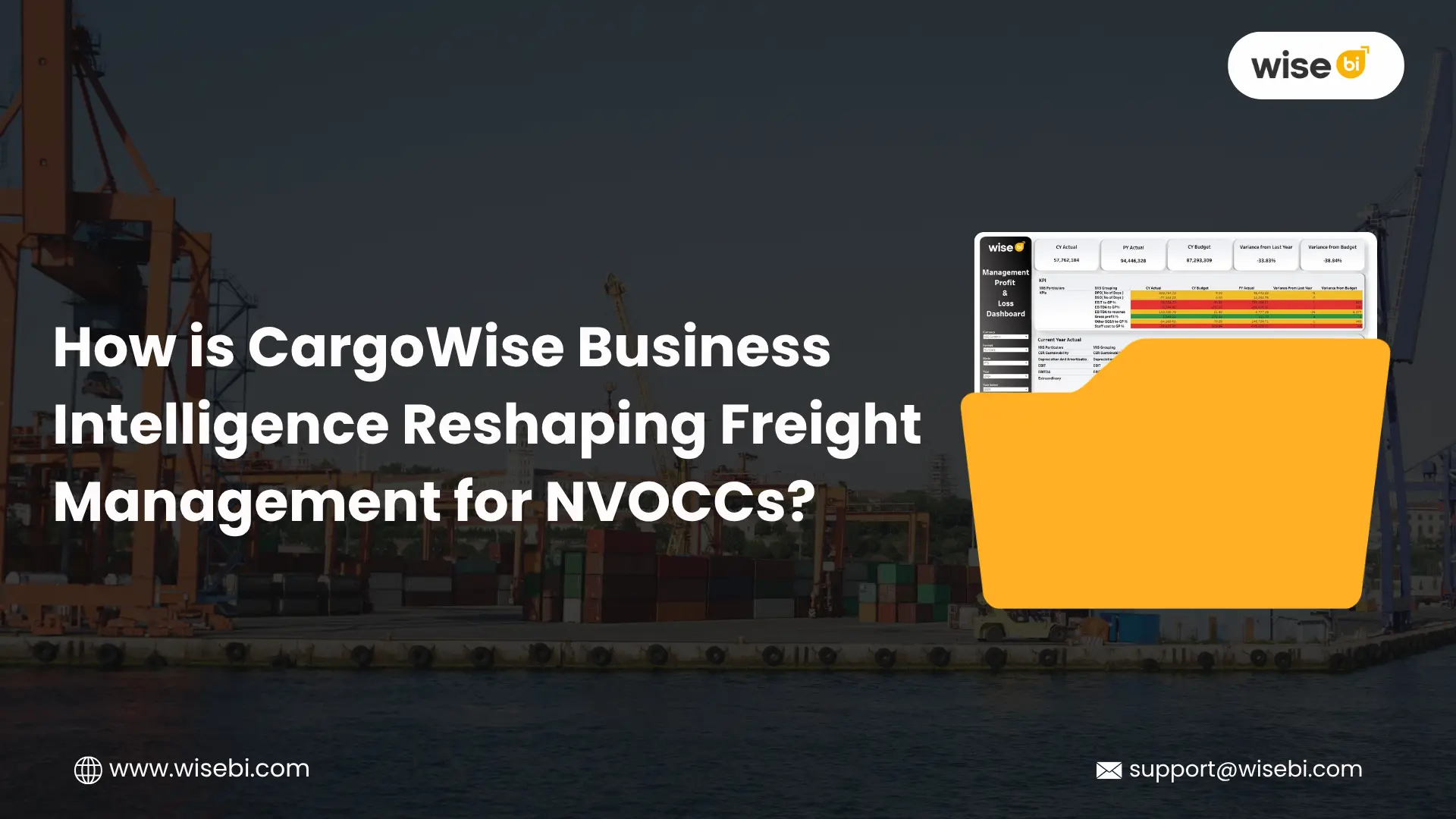
A connected CargoWise KPI & performance overview dashboard allows teams to move from high-level KPIs into the underlying business information and investigate what is driving performance.
That’s where dashboards start supporting decisions rather than simply reporting results.
🤖 AI Can Make CargoWise Data Easier to Explore
AI is adding another layer to business intelligence.
Instead of manually moving between dashboards, filters, and reports, AI-powered business intelligence analytics can help users explore CargoWise data using natural-language questions, identify unusual changes, summarize patterns, and investigate performance more quickly.
For example:
“Which customers experienced the largest margin decline this month?”
Or:
“Which trade lanes are showing unusual cost increases?”
The goal isn’t to replace experienced freight professionals or finance teams.
It’s to reduce the time spent searching for information so people can spend more time deciding what to do with it.
Recent industry research shows logistics organizations are increasingly looking beyond basic visibility toward predictive and actionable intelligence. For CargoWise-based NVOCCs, this makes the quality and structure of their underlying data increasingly important.
📈 Move From Historical CargoWise Reporting to Forward-Looking Insights
Traditional reporting mainly explains what has already happened.
Modern analytics can go further.
Historical CargoWise data can help identify recurring patterns across shipment volumes, customers, trade lanes, costs, and operational performance.
Predictive analytics can then help businesses explore where performance may be heading.
That could support questions around future shipment volumes, changing customer activity, emerging cost pressure, profitability trends, or recurring operational exceptions.
It doesn’t mean BI can predict every freight disruption.
It means management can use existing CargoWise data more effectively to prepare for what may happen next.
📣 Final Thoughts
For NVOCCs, the opportunity isn’t simply collecting more freight data.
CargoWise is already generating valuable operational and financial information throughout the business.
The bigger opportunity is connecting that information so leaders can understand customers, trade lanes, costs, margins, shipment activity, and operational performance together.
With the right logistics BI solution, CargoWise data can be transformed into interactive dashboards, AI-powered analytics, and decision-ready insights, helping NVOCCs move beyond freight reporting and make faster, more informed business decisions.